Alakazam Studio: Open Source ComfyUI World Model

The Missing Layer Just Arrived
World models are exploding. Genie-style systems, Reactor, MIRA Mini, local ONNX experiments—everyone is racing to turn a single frame plus a prompt into a living, steerable video world. But most of them still leave you staring at a black box. You can generate, but you cannot author. You cannot version. You cannot treat the world like a programmable state machine that a game designer would actually ship.
That gap just closed.
Alakazam Studio is the first local, open-source creator studio built specifically for world models. Sentence goes in. You edit the state graph. You hit play—on a live model running in your browser, yours or anyone else’s. Apache-2.0. No weights shipped. No GPU code. Pure static React app that talks only to the providers you configure.
This is ComfyUI energy applied to interactive worlds.
What a World Actually Is Here
Under the hood a world is a deliberately small state machine.
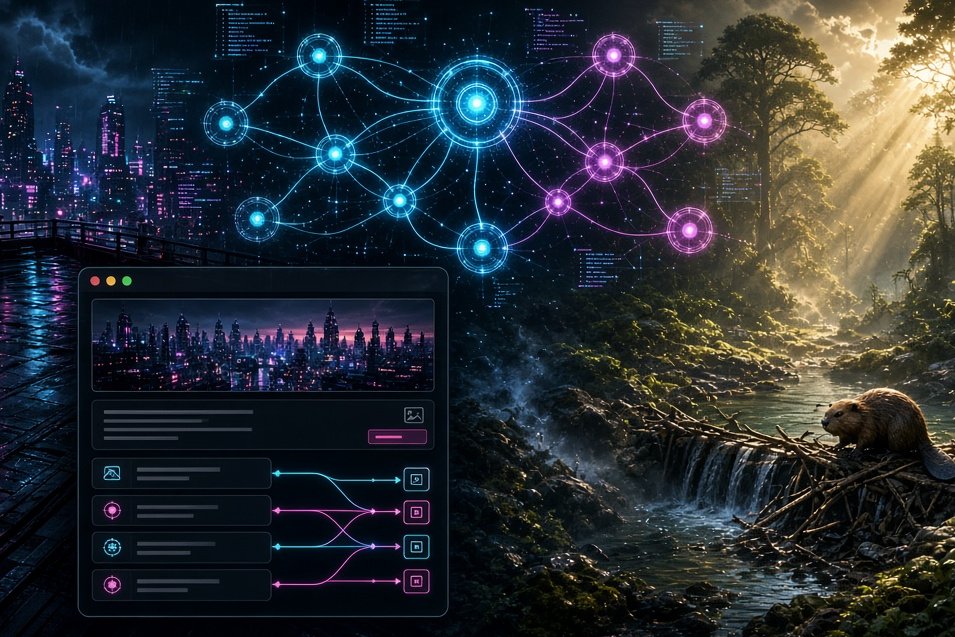
States hold the prose prompts that describe the current scene. Events are the transitions triggered by player actions. The studio lets you author that graph, version it, snapshot it, diff it, restore it, then push the compiled graph into whatever world-model backend you have connected. The model paints the frames. The graph holds the logic, the goals, the memory, the win conditions—the parts a pure world model still cannot own on its own.
That dual-loop idea is the real product. The world model is the renderer. The studio is the authoring and orchestration layer. Swap the model tomorrow and your graphs keep working.
Bring Your Own Everything
Two independent provider slots:
World models
- mock (default, pure offline canvas)
- reactor (api.reactor.inc)
- websocket (any endpoint that speaks the documented protocol)
- alakazam (their hosted service)
LLMsAny OpenAI-compatible /chat/completions endpoint. Presets already exist for Cerebras, Grok, OpenAI, OpenRouter, Ollama, LM Studio, vLLM, llama.cpp, TGI, LiteLLM, and custom. Local models need no key.
You can run the entire studio against a local ONNX Doom-style model or a MIRA Mini car-soccer world on Apple silicon while an LLM on your laptop writes the quest graph for you. Or point both ends at production services. The studio does not care.
Capabilities are probed automatically. If a backend cannot accept promptable events mid-session, you get a clean warning instead of silent failure.
Hands-On in Under Two Minutes
git clone https://github.com/Alakazam-studios/alakazam-studio
cd alakazam-studio
npm install
npm run dev
Open http://localhost:4321. No account. No .env. The mock provider is already live. Drop an LLM key into Settings and you can start authoring from natural language. Drop a Reactor key or a local WebSocket endpoint and the canvas becomes video.
Want Docker?
docker compose up -dSame URL. Everything still lives in the browser’s localStorage and a simple ~/.alakazam-studio/worlds.json for the CLI.
The CLI mirrors the entire UI tool tree:
npm run studio -- world create --example
npm run studio -- author state add myworld --base "Rain on the lane." --id rain
npm run studio -- world export > worlds.json
Why This Matters for Game Developers Right Now
Most world-model demos are still one-shot experiences. Pretty, but not games. Alakazam Studio forces the conversation toward deterministic structure: entrance states, event graphs, objectives, version history. That is the layer that actually turns a generative renderer into something you can playtest, balance, and ship.
It is also the first practical place where an LLM agent and a world model sit side-by-side with a clean separation of concerns. The LLM writes and rewrites the graph. The world model executes the visual loop. You stay in the middle as the director.
Pro Tip: Start every new world with the mock provider and a strong local LLM. Get the graph tight and the event language crisp before you ever burn inference credits or GPU cycles. The studio’s candidate-preview and validate tools make this iteration stupidly fast.
The Bigger Picture
Hugo Thomel and the Alakazam team have been public for months about the dual-loop architecture: LLMs own the quest and state scaffolding, world models own the perceptual loop. The commercial platform at alakazam.gg already runs this. Alakazam Studio is the open-source authoring surface for the same philosophy—now available for anyone to fork, point at their own models, and extend.
World models are becoming commodities. The real moat is the layer that turns any of them into authored, rule-bound, playable experiences. That layer just shipped under Apache-2.0.
Clone it. Point it at your model. Start building the worlds that only exist because you decided they should.
The frontier just got a proper workbench.
—Titus