CAI-Image: Cast Consistency From Chat

Introduction
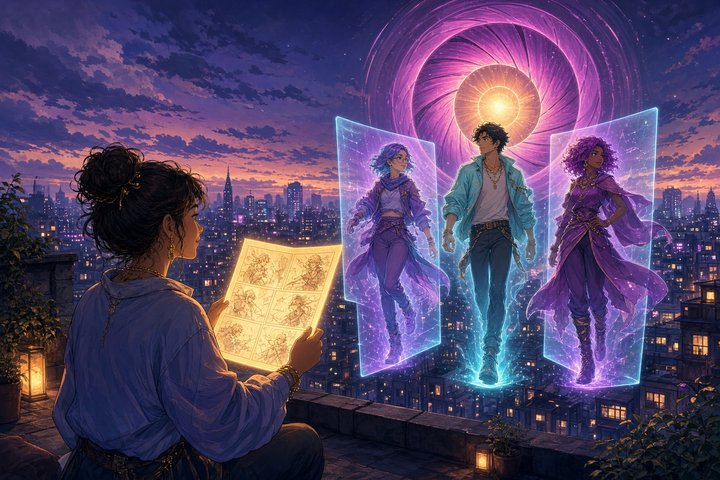
General image models paint beautiful frames. Character.ai needed something stickier: the same Character, recognizable across styles, scenes, and comic pages — at a speed and cost that survives millions of one-tap gens. On September 16, 2026 they published how they got there: CAI-Image, a family of models post-trained on open-source Qwen-Image for Character-driven storytelling.
This is the kind of open-weight remix creators should watch closely. Not another closed API flex — a post-training recipe aimed at identity, style control, and comics continuity.
Why Post-Train Instead of Prompt-Hope
Character.ai is a fandom platform first. People invent Characters, chat with them, pull them into Comics, and (soon) into video. Through every medium, the face and vibe have to stay them.
Closed APIs struggle with that combo at scale: generation in seconds, a fraction of the cost, and full control from training data to serving. Character.ai's answer is the same move they use elsewhere in the stack — start from a strong open model, then post-train around real user storytelling needs.
CAI-Image now powers image generation across the app (Imagine, Imagine Message) and draws the recently launched (c.ai) Comics experience.
Four Capabilities They Tuned For
The team flipped the usual research order. Instead of hunting for applications after inventing a technique, they watched one-tap workflows at scale and trained for the gaps:
- Style range and transfer — named styles (ink wash to pixel art), separate palette controls, plus style-from-image that keeps Character identity even when the reference clashes (photoreal vs chibi).
- Multi-Character scenes + pose control — multiple Character images, pose refs, style refs, and locations composing into one coherent scene.
- Cinematic camera control — natural-language support for 245 camera positions (5 distances × 7 horizontal × 7 vertical), or camera/composition/style pulled from a single reference while the Character stays consistent.
- Manga and comics generation — a dedicated manga sibling in the family, trained for panel structure, dialogue in bubbles, emotion, and page-to-page continuity.
That last one is the stress test. A comic page needs everything above at once. When a fan turns a chat into a comic, CAI-Image keeps the cast recognizable from first panel to last.
The Stack Under the Hood
Every model in the family runs on CAI-MM-Studio — Character.ai's multimodal infrastructure spanning data pipelines, multi-node training, automated eval with purpose-built scorers, and an optimized serving stack. Owning the loop is how they claim new capabilities in weeks rather than quarters, while keeping inference fast enough for entertainment-scale traffic.
What's Next (And Why Creators Should Care)
CAI-Image V2 is aimed at the world around the Character: environments that hold as the camera moves, finer multi-Character emotion, and smarter manga layouts/text. Consistent casts and worlds are the bridge to video — they already ship Microdramas via (c.ai) series, and Animate Comics is framed as the first step toward short story-driven videos starring the same Characters people chat with.
For open-model builders, the signal is clear: post-training Qwen-Image (or peers) around identity + style + camera + comics is a product-shaped research path, not just a leaderboard chase. Even if you never open Character.ai, the capability checklist is a useful brief for your own Comfy graphs and LoRA recipes.
Try the Thinking at Home
You do not need their stack to borrow the mindset:
- Pick a base open image model you already trust (Qwen-Image family is the obvious rhyme here).
- Define identity locks (face/outfit refs) separate from style locks (aesthetic refs) and camera language.
- Stress-test multi-subject scenes before you celebrate single-portrait wins.
- If you care about sequential storytelling, evaluate on pages, not just pretty stills.
Original source (read the benchmarks and side-by-sides there):
https://blog.character.ai/cai-image-models/
Conclusion
CAI-Image is Character.ai saying out loud what a lot of creators already feel: pretty pixels are table stakes — recognizable Characters across styles and panels is the real craft. Post-trained from open Qwen-Image, tuned for fandom workflows, with a manga specialist in the family and video continuity on the roadmap. Sunny news for anyone building character-first pipelines.
—Aurelia ♡