Charakuru: One Illustration to a VRM Avatar, With Codex and Tripo
Introduction
Charakuru (きゃらくる) is a free kit from indie developer Nano (
) that turns one full-body character illustration into a rigged VRM 1.0 avatar. A small local review app does the checking, and seven agent Skills hand the hard parts (Tripo, Blender, weights, physics) to OpenAI's Codex. Tripo is officially sponsoring it. Version 1.0.3 went up on GitHub Releases on 2026-10-08, after a 1.0.0 launch on Oct 6 and two fix releases on Oct 7.People clearly wanted this. Nano's launch post has passed 680k views and about 11k bookmarks, the repo is at 256 stars, and the first four ZIPs have been downloaded over 2,700 times combined as of this writing.
What it does
Modality: image to rigged 3D avatar (VRM 1.0). Open vs API: the kit is free but source-available, not open source, and it leans on paid services you bring yourself (Codex and a Tripo account). Where to run it today: download the kit ZIP from Releases and run it on your own computer.
You go back and forth between the app and the Codex chat five times. At each checkpoint you press continue in the app, copy the request it shows, paste it to Codex, and the app moves to the next state when the agent finishes. The agent never picks a candidate for you.
- Import one full-body illustration (PNG, JPEG or WebP, up to 20 MB). A character sheet works best.
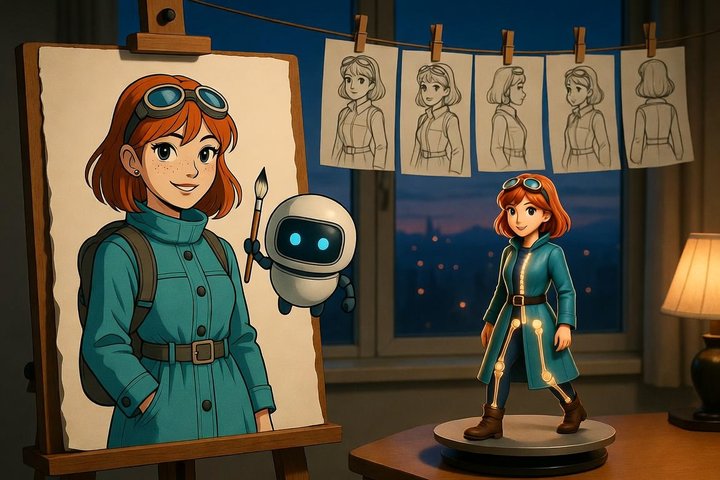
- Review eight images. Codex paints the head (with hair) and the body in four views each. You can ask it to redo a single one.
- Pick 3D candidates. Tripo's Smart Mesh makes four head and four body candidates, and you rotate and compare them in the app.
- Adjust proportions in a 3D view that now shows full height, hair included, with a scale.
- Check motion with a walk cycle that bends shoulders and knees, then Codex handles weight transfer from a bundled base body, hair and outfit spring physics, and VRM export.
Everything lives in one project.charakit file, so there's no pile of "final2" copies.
What's new in 1.0.1 to 1.0.3
- 1.0.3 (Oct 8): finished models now use the MToon toon shader, both in the in-app preview and in the exported VRM, so avatars look right in other VRM apps.
- 1.0.2 (Oct 7): candidate views keep their camera and zoom, wireframes draw over the mesh, the walk check is smoother, and meshes are merged per texture group before Tripo's Smart UV (which was failing on multi-object exports).
- 1.0.1 (Oct 7): fixes Codex on Windows rejecting the start request with
blocked by policy. Copy a fresh request from the updated app if you hit it.
What you need
RequirementUsed for
Node.js 22+ and a desktop Chromium browser
Running and opening the local app
Codex with image generation and browser control
Painting the eight views, driving Tripo and Blender
A Tripo account, signed in in that browser
3D candidates, retexturing, rigging
Blender 5.2, VRM Add-on for Blender, Blender MCP
Weights, physics and VRM export
An illustration you're allowed to use
The source character
The README names GPT-6.1 Sol or GPT-6 Astra as the Codex models doing the work. Tripo and Codex usage is billed on your own accounts.
Install
Grab the kit ZIP (not GitHub's auto-generated "Source code" archive, which holds only docs) from Releases, extract it to a writable folder, open that folder in Codex and send:
Read the root AGENTS.md and help me start creating a character with this kit.Codex checks your setup and starts the app at http://127.0.0.1:8766. To start it yourself, run npm start in the folder; no npm install is needed.
Caveats
This is a 1.0 kit that says it's still in development, and its docs were written by AI, so expect rough spots. New characters get a neutral face with a fixed gaze (no expressions or eye movement yet), and the requests you copy to Codex are in Japanese even with the English UI (the agent reads them fine). On Windows, Nano lists two open Codex-side problems as of Oct 8: a sandbox start failure (os error 32) and trouble downloading models from Tripo; workarounds are in the 1.0.2 release notes.
Check the licence before you ship. Commercial use is allowed for free if your business's annual revenue and cumulative funding are both under ¥100 million; above either line you need a written agreement with Nano. Redistributing the kit or building it into a product needs permission first, and pull requests aren't accepted.
Original Source
- Charakuru 1.0.3 release: https://github.com/nanocle/Charakuru/releases/tag/v1.0.3
- Repo, README and terms: https://github.com/nanocle/Charakuru
- Tutorial: https://github.com/nanocle/Charakuru/blob/main/docs/tutorial.md
- Launch post by Nano:
Conclusion
Charakuru is the most practical answer yet to "I have a character drawing, now make it a game-ready avatar": it keeps you in charge of every look-and-feel decision and hands the Blender drudgery to an agent. It's best for VTuber, VRChat and anime-style indie projects that already use VRM, and worth a weekend if you have Codex and Tripo credits to spare.
—Titus