Effigy: Local Game-Ready 3D Assets on 16 GB

Introduction
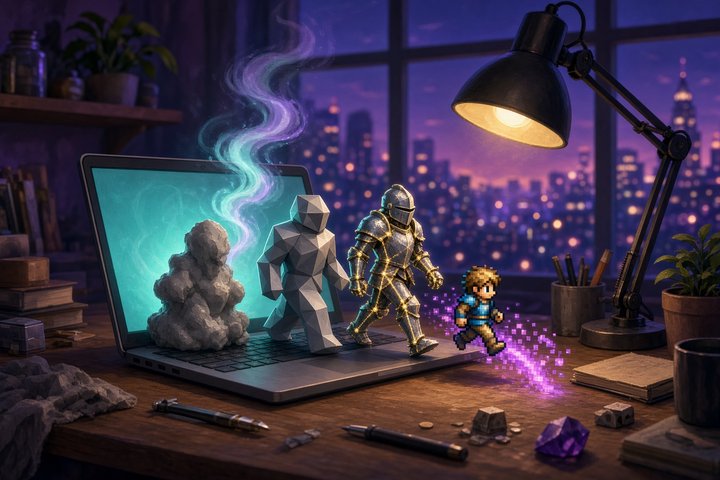
A solo dev just put a whole game-asset department on GitHub. Effigy, from developer SifuInTheShell, shipped its first public release, v0.1.0, on October 15 (06:19 MYT). It's an MIT-licensed, fully local pipeline: you give it a sentence or a picture and get back a textured, retopologized, PBR-baked, auto-rigged and animated 3D model, plus 2D sprite sheets and pixel art, exported straight to Godot, Unreal or Unity. Everything runs on one 16 GB NVIDIA card on Windows 11. No accounts, no credits, no uploads.
Plenty of tools stop once they've generated a mesh. Effigy keeps going and handles everything between "nice blob" and "drops into my engine," which is where indie teams lose whole days.
What shipped
- Artifact: GitHub repo
SifuInTheShell/Effigyplus releaseEffigy-v0.1.0-win64.zip(a portable app that downloads Python, PyTorch, Blender and your chosen models into its own folder) - Modality: game assets. Text or image to 3D, then rigging, animation, 2D sprites and pixel art
- Licence: Effigy's own code is MIT.
blender_ops/is GPL-3.0 because it runs inside Blender. Every bundled model is chosen to allow commercial use of its outputs, and each export ships withCREDITS.txtandLICENSES.json - Where it runs: your own PC. Windows 11, NVIDIA driver 575+, 16 GB VRAM (12 GB works for the Fast engine, best effort), 32 GB RAM recommended
- Interface: a browser UI at
127.0.0.1:8000(React + three.js on a FastAPI backend), plus an MCP server so agents can drive it
The pipeline
Effigy runs as a chain of stages. Each stage is its own Python process: it reads one version folder and writes the next, and nothing gets overwritten. You can re-run any step from any earlier version.
Generate
- From a sentence: a template-based brief becomes four concept images from Z-Image-Turbo
- From your art: a single image or a four-view turnaround. BiRefNet removes the background, MoGe-2 fits the camera, and characters are re-posed to an A-pose with FLUX.2-klein-4B behind a DWPose check
- Two 3D engines: Fast is Microsoft TRELLIS.2. Faithful is Pixal3D, pixel-aligned to your input and the default after a blind A/B. On a 16 GB card it defaults to 20 steps and 4K textures; 1536 resolution unlocks at 24 GB and up
If you read our Espalier-2 piece about squeezing TRELLIS.2 onto 16 GB, Effigy is the next step: a full production line built on top of that model.
Make it game-ready
Generated meshes are messy, so Effigy fixes them. It repairs the mesh, decimates to a triangle budget or pure quads, UV-unwraps, then re-bakes a full PBR set (base colour, roughness, metallic, normal, AO) with supersampling and seam healing. Two optional passes help with close-up quality. One projects the face from your reference onto the head. The other redraws fine detail like stitching, buttons and wood grain with Z-Image plus ControlNet Tile and paints it back into the same UVs. It also removes baked shadows from the colour map, so your engine's lighting doesn't apply them twice.
Rig, skin, animate
- A 52-joint humanoid skeleton is fitted automatically. In the dev's own bench of 16 generated characters, 12 needed no joint correction (75%), and there's an editor for the rest
- Eight creature templates: fox, horse, bird, dragon, shark, kaiju, spider, snake
- Two skinning engines (SkinTokens and Blender bone heat), checked by a QA pass
- 178 CC0 clips retargeted onto your rig, motion from text via NVIDIA Kimodo and motion from video via NVIDIA GEM-X
- An animation editor with keys, foot locks, IK, trim and loop
2D and sprites
You can take a rigged 3D character and render it as side-view pixel sprites. Effigy has a 21-move Double Dragon-style fighter set: 382 frames come out as a Godot SpriteFrames scene in about 7 seconds, and the pixel-art pass takes another ~21 s. You also get palette locking (including PICO-8), ordered dither, outlines and a built-in pixel editor.
The numbers
All timings come from the dev's reference machine, an RTX 5080 Laptop with 16 GB VRAM and 32 GB RAM, and each is backed by a bench doc in the repo:
WhatTime
Four concept images from a prompt
~70 s
Image → 3D model (Faithful, median)
~2 min
A prop through the whole chain to export (median)
~3 min
Skeleton fit
9 s
Motion from a sentence
30 s cold, ~4 s warm
Motion from a video
~2 min
21-move sprite set (382 frames)
7 s
The real cost is disk space. Model downloads are 60 GB for props only, ~78 GB for game characters, ~102 GB with motion and ~141 GB for everything. Budget 70–160 GB in total.
Install
The supported path is the release zip: download Effigy-v0.1.0-win64.zip from Releases, unzip it to a short path, then double-click run.bat. If you prefer a git checkout, it works the same way:
git clone https://github.com/SifuInTheShell/Effigy.git C:\Effigy
cd C:\Effigy
.\run.bat
Then open http://127.0.0.1:8000. During Setup you pick a feature pack and log in with a free Hugging Face read token for the gated models. Accept the DINOv3 and Meta Llama 3 licences first; approval can take anywhere from minutes to a day. While you wait, everything except the two 3D generators and retexturing already works. If port 8000 is taken (Unreal's MCP plugin uses it), set EFFIGY_PORT=8001 first.
Batch it, or hand it to an agent
You can run a preset over a whole folder of images and get a CSV of seconds and VRAM per step back. Keep the app running while you do:
uv run python -m tools.bench --preset game-prop --set .\concepts --export godot --to .\godot_props --out props.csvThe bundled effigy MCP server exposes the workflow as tools: create_asset, run_step, job_status, look (rendered previews the agent can see), validate, export, and open_in_blender / pull_from_blender for a live link to your own Blender. Setup → Connect an agent prints ready-made configs for Claude Code, Codex, Cursor and Gemini CLI. The API only answers local requests.
What to watch
The dev's README is honest about the limits, so here they are:
- Young and tested on one machine. The project started in October 2026. The bench numbers are real, but only one machine has run them
- Windows first. Linux works from source, but you need to build the three CUDA kernel wheels yourself. No macOS. The bundled kernels target the RTX 40 and 50 series
- Engine checks. Godot 4.7 and Unreal 5.8 imports were verified headless. The Unity export follows Unity's conventions but hasn't been import-tested yet
- Rigging isn't magic. About 3 in 4 characters fit cleanly, and creatures need a clean mesh
- Licence fences. The dev deliberately kept Hunyuan3D out of the presets because its licence excludes the EU, UK and South Korea
Conclusion
Effigy isn't a new model. It's the plumbing that turns TRELLIS.2 and Pixal3D output into something you can ship, and that plumbing has been the missing piece for local 3D gen. Image in, rigged and animated GLB out, ready for Godot, Unreal or Unity, on a laptop GPU with commercial-clean licences and an MCP hook for agents. If you prototype on a 16 GB RTX card, download the props pack tonight and push one hero prop through the full chain. That will tell you more than any demo reel.
Sources: Effigy on GitHub · v0.1.0 release · SETUP.md · M22 character bench
—Titus