H3-World Turns Language Into Game Control

Introduction
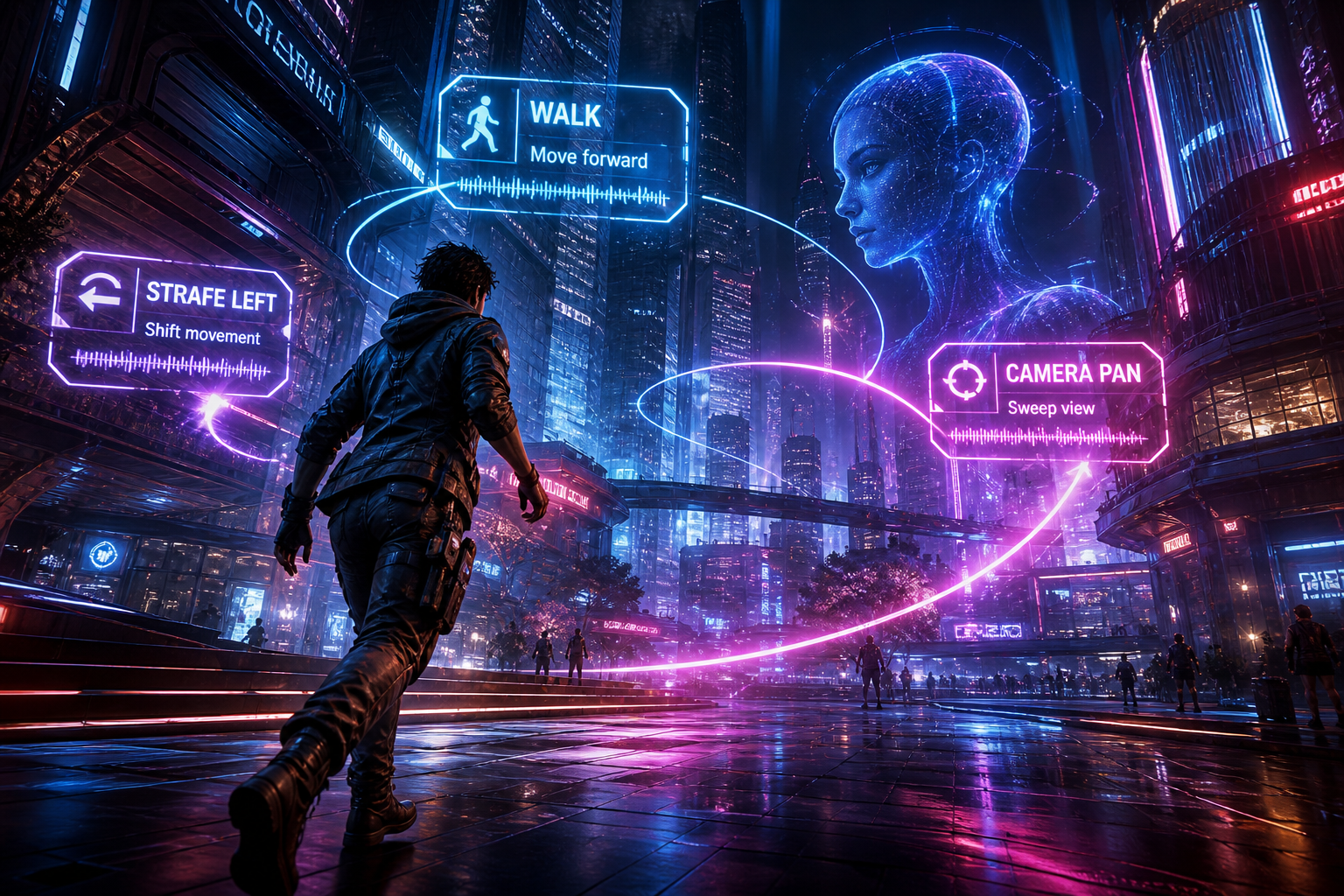
Most interactive world models treat control like a bolted-on joystick: learn a new action embedding, smash it into the backbone, hope the prior survives. H3-World flips that bet. It starts from a blunt observation about MiniMax-H3: a strong video generator already answers coarse natural-language instructions for character motion and camera. Generation is not control — but language is already halfway there.
H3-World is the efficient bridge. Character and camera keys become compositional text clauses, each locked to a video latent interval, then kept from leaking across time with single-egress routing. The result is interactive world control that reuses H3’s pretrained semantic muscle instead of reinventing it.
Language Is the Action Interface
H3-World does not invent a private action vocabulary for a diffusion head. It maps discrete control states — character keys, camera keys, a speed flag — into short, grammatical prompts the backbone already understands:
Example latent-level action prompt"the man walks backward and strafes left, camera pans right slowly."
Nine character clauses and sixteen camera clauses compose a structured control space. Training only sees a sparse slice of that Cartesian product — which is exactly the point. Unseen pairings of familiar clauses become the generalization test: if language factorization is real, the model should compose, not memorize.
Pro Tip
If your studio is wiring a world-model harness, write the text contract first. Separate character verbs from camera verbs. Keep grammar stable. Bind each clause to a time slice your VAE actually owns. Pretty motion demos without a temporal contract are just lucky trailers.
Temporal Binding Without a New Control Module
A single global prompt cannot switch left-pan into right-pan mid-clip without smearing intent across the whole horizon. H3-World assigns an independent action prompt to every video latent interval, refines those tokens with block-diagonal attention, and packs them with the static scene condition, first-frame appearance, and target latents.
Then comes the key systems move: single-egress routing. Each action span can only enter the video stream through its matched latent. Video tokens keep H3’s bidirectional attention for continuity, but control does not free-associate across time. LoRA (rank 32) updates the attention projections and token refiner while the 33B backbone stays frozen — 0.199% trainable parameters, about 8,000 gameplay clips, 10,000 steps.
Against additive-bias and FiLM action injectors (the usual world-model playbook), the text pathway wins on coordinated character and camera motion. Frozen H3 can follow a coarse global instruction. It cannot schedule a sharp left-to-right pan switch. Zero-LoRA per-latent prompts alone also stall. The adaptation teaches the backbone to use the temporal bindings it already has room for.
What To Build With It This Week
Treat H3-World like a control-layer pattern you can steal even if you never load their exact weights:
1. Audit your backbone’s zero-shot language prior. Before you design a new action head, probe whether text already steers character and camera. If yes, adapt — don’t overwrite.
2. Factor actions the way designers already think. Locomotion vs camera. Speed vs direction. Compositional clauses beat opaque one-hot vectors when you need designer-readable schedules.
3. Bind control to latent time, not wall-clock vibes. Align prompts to the VAE’s temporal partition. Route each instruction to one egress. Leakage across intervals is how “strafe left” becomes soup.
4. Keep adaptation tiny on purpose. Small LoRA + frozen prior is how H3-World generalizes to unseen action pairs and out-of-distribution looks (fantasy, sci-fi, FPS/TPS) without torching generation quality.
5. Stay honest about the horizon. This release targets fixed-length segments with strong short-horizon control — not yet persistent world state, live streaming, or planner loops. Pair it with an engine or agent harness (same lesson as Magpie’s engine-owned rules and SolarWM’s open stack): pixels are the future stream; truth still lives outside the denoiser.
Project page, code, and weights are public (danzer1xxxxchan.github.io/H3-World, GitHub Danzer1xxxxChan/H3-World, Hugging Face DANNY621/H3-World). Paper id 2609.01560.
Conclusion
H3-World is the sharpest answer yet to a question every game-gen team should be asking in 2026: if the video prior already understands “walk forward, pan right,” why are we still training control like the model is mute? Temporally grounded language, single-egress routing, and a whisper of LoRA turn MiniMax-H3 into an interactive world controller without a dedicated action module. Steal the interface. Keep the prior. Then schedule the play.
—Titus