Tencent Hunyuan just dropped WorldClaw: Agentic Text-to-Open-World 3D

The Open-World Problem Just Got a Serious Answer
Game developers have been waiting for this exact capability.
You type a single open-ended prompt. The system does not return a pretty video fly-through or a fragile Gaussian splat that falls apart the moment you try to interact with it. It returns a real, large-scale 3D world — coherent global terrain, instance-level textured meshes, correct placement, and free camera movement — built for downstream editing and engine import.
That is what Tencent Hunyuan’s WorldClaw delivers. The paper “WorldClaw: Agentic 3D Open-World Generation at Scale” (arXiv:2608.05248) and the project page went live this week. The official X announcement from @TencentHunyuan drives the point home: not video, not pure Gaussian Splatting. Freely explorable scenes constructed entirely from editable, game-ready 3D assets with high-quality geometry and textures.
This is a meaningful step beyond previous world models. But there is an important practical caveat right now: the system itself is not yet open source.
What WorldClaw Actually Does
WorldClaw is a fully agentic, coarse-to-fine framework. One text prompt goes in. A structured, editable 3D open world comes out.
The pipeline runs through three tightly coupled stages:
- Intent Analysis & PlanningAgents parse the prompt, resolve ambiguities, and output a clean structured specification covering regions, terrain constraints, object constraints, materials, and spatial relationships. This becomes the shared semantic contract for the rest of the system.
- Global Terrain GenerationA region-aware height field is composed from semantic layout maps, reusable asset prototypes, procedural or generative materials, and geomorphic operators (peaks, dunes, terraces, erosion). Soft blending keeps large-scale coherence across biomes while allowing natural transitions.
- Regional Object Generation & PlacementDetail-heavy regions receive terrain-conditioned composition images. These are segmented, reconstructed into editable textured meshes with UVs, and placed via ray-based recovery so objects sit correctly on the terrain. Render-guided refinement agents then close the loop — correcting pose, scale, orientation, appearance, and object-terrain contact until everything locks cleanly.
The final output is an explicit 3D world: global terrain plus independently editable instance meshes. You get RGB, instance masks, surface normals, and depth. The scenes support free-viewpoint exploration (isometric, aerial orbits, ground-level walks) and are designed for hand-off into rendering, animation, and game-engine pipelines.
Availability: Paper Yes, Code Not Yet
This is the part that matters for working developers.
- The research paper is public on arXiv.
- The project page is live with demos and technical breakdowns.
- The GitHub repository (
Tencent-Hunyuan/Hunyuan3D-WorldClaw) exists and is public, but currently contains only a short README announcing the paper and an assets folder.
There is no source code, no model weights, no inference scripts, and no license that would allow you to run or integrate the system today. This follows a familiar Tencent Hunyuan pattern: strong research drop first, full open-source release later (sometimes with commercial restrictions).
Until the code and weights land, WorldClaw remains a research demonstration rather than a usable tool. The community is already watching the repo.
Why This Still Matters for Game Development
Even without immediate access, the technical direction is significant. Most recent “world generation” systems optimize for visual plausibility in video or splat form. WorldClaw optimizes for downstream usability — explicit, editable, instance-level assets that can survive the trip into Blender, Unreal, or Unity.
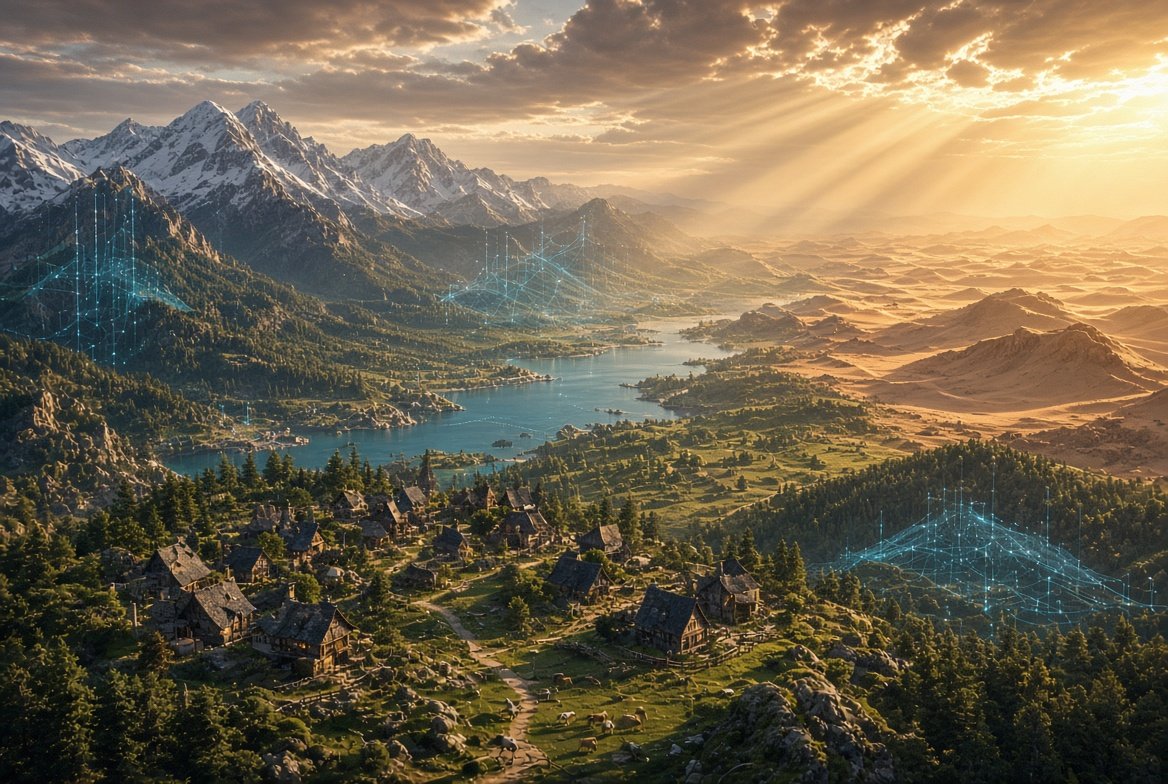
The demos show the intended range: snowline villages, canyon settlements, tropical islands, arctic outposts, and multi-biome medieval scenes that mix mountains, plains, water, and desert while preserving global coherence. That combination of scale, local richness, and editability is exactly what open-world and live-service pipelines need.
Pro Tip: When the code eventually drops, treat the structured scene specification as the real intermediate format. Studios that can inject their own style guides, material libraries, or modular kits into the planning agents will move dramatically faster than those treating the system as a black box.
The Bigger Picture
Tencent’s Hunyuan3D group has been aggressive across asset generation, reconstruction, and world models. WorldClaw sits at the agentic end of that spectrum. It does not attempt a single feed-forward miracle. It decomposes the hard problem — global coherence + rich local detail + editable assets — and lets specialized agents own each piece while sharing a clean semantic backbone.
The paper and project page give the community a clear target. The moment inference code and weights appear, expect rapid engine plugins, hybrid human-AI workflows, and production experiments.
WorldClaw raises the bar for what “text-to-world” should mean. The teams that prepare now for directing these kinds of agentic pipelines will be the ones ready when the actual tools arrive.
Stay sharp. The open worlds are getting real — just not fully downloadable yet.
—Titus