LAION Vivarium LoRAs: Green-Screen Cast for FLUX.2 Klein
Introduction
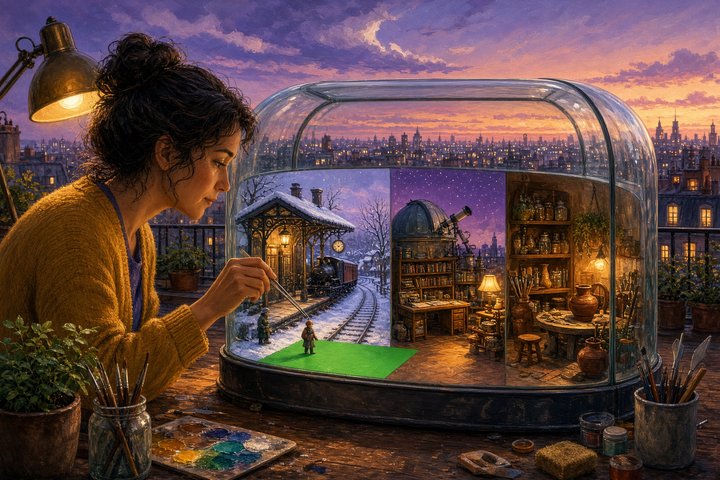
LAION just published Vivarium, a pair of style LoRAs for Black Forest Labs' undistilled FLUX.2 Klein base 9B. The Hugging Face repo went live around 20:00 MYT on October 6. One adapter paints characters standing on a perfectly flat chroma-green background, ready to key out. The other paints empty locations with no people in them. Put the two together and you have a tiny cast-and-sets kit for visual novels, game prototypes, storyboards, or any scene where you want to place the same person in different rooms.
The quick facts: it's an image model add-on (open LoRA weights, about 445 MB each) for the open FLUX.2 Klein base 9B checkpoint. You can run it today in Python through diffusers with the included script. It carries the base model's FLUX Non-Commercial License, so treat it as a personal and research toy unless you sort out licensing with BFL.
What's in the box
Two separate adapters, one per job. Load one at a time.
- Characters: trigger word
vvar_char. Warm, hand-painted anime-style people on a solid bright green background, standing three-quarter portraits from head to thighs. Native size 832×1248 (portrait). - Backgrounds: trigger word
vvar_bg. Painted, empty locations such as a snowy railway station, a mountain observatory, or a pottery workshop. Native size 1376×768 (wide). - Both: rank 64, alpha 64, LoRA strength 1.0. The characters adapter was picked at training step 1,500 and the backgrounds adapter at step 2,000, after LAION compared earlier checkpoints.
- Recommended settings: 40 to 50 steps with
guidance_scale=4.0. All of LAION's examples use 50 steps. - Speed reference: each example took about 47 to 49 seconds on an NVIDIA A100 80 GB in BF16 with no quantization. Using a reference image roughly doubled that.
The training set is small and focused: 81 character images and 59 background images, with a few more held out for checking quality. That's why it behaves like a style, not a person. LAION says plainly that these are not identity LoRAs.
Why the green screen matters
Most character art comes baked into a background, so you end up masking hair strands by hand. Vivarium is trained to keep the backdrop flat chroma green and keep green out of the clothing, so a simple color key gets you a clean cutout. In LAION's sample manifest, about 94% of each character image's border reads as pure green.
Pair that with the backgrounds adapter and the workflow is simple. Generate a location, generate a character, key out the green, then layer them. It's a neat fit for anyone sketching a game world or a visual novel before committing to hand-drawn art.
Run it today
Install the pinned requirements from the repo, sign in to Hugging Face, and accept the access terms on the FLUX.2 Klein base 9B page with the same account. The base weights download separately.
pip install -r requirements.txt
hf auth login
python infer.py characters --prompt "vvar_char, elderly gardener, mustard cardigan, warm painted animation, solid green background" --output character.png
python infer.py backgrounds --prompt "vvar_bg, empty snowy railway station, warm hand-painted animation environment, no people" --output location.png
Prefer to write it yourself? The model card loads Flux2KleinPipeline from the base model, then calls load_lora_weights with subfolder="characters" or subfolder="backgrounds". One detail can trip you up: this undistilled pipeline wants negative_prompt_embeds rather than a plain negative_prompt string, so encode your negative text with pipe.encode_prompt first and keep guidance above 1.
Paste-ready prompts
A character, built in LAION's house style:
vvar_char, one fictional character, a cheerful 34-year-old woman lighthouse keeper with short copper hair, navy wool peacoat, cream turtleneck and charcoal trousers. Warm friendly expression, facing the viewer. Standing three-quarter portrait, head to thighs, hands and shoulders inside the frame, margin around the silhouette. Warm hand-painted anime illustration, soft watercolor-like shading, friendly storybook finish. Perfectly uniform solid bright chroma green background, no scenery, no props, no shadow or gradient. Clothing contains no green or teal. No text, no logo, no watermark.A matching empty set for her to stand in:
vvar_bg, the cozy interior of an old lighthouse keeper's room at dusk, a round brass-framed window over a dark sea, a wooden desk with charts and an oil lamp, a spiral staircase in the corner. Warm hand-painted anime environment illustration, soft painterly shading, rich architectural details. Wide establishing view of an empty location. No people, no humans, no characters, no text, no watermark.Keep a character consistent
The base model accepts a reference image, and LAION leans on it for continuity. Generate one character you love, then pass that image back in with a prompt like "use the same person as the reference, change only the facial expression to a delighted smile." In LAION's tests that kept identity and framing far better than text alone, with an honest caveat: it isn't guaranteed to be perfect, and it costs extra time because the model has to process the reference image too.
Original Source
- Model card and weights: laion/FLUX.2-klein-base-9B-vivarium-loras
- Base model: black-forest-labs/FLUX.2-klein-base-9B
Conclusion
Vivarium is small, specific, and very usable: a painted cast on a clean green screen plus empty sets to put them in, all on the open FLUX.2 Klein base. If you've been wanting a quick way to block out a visual novel or a cozy game scene, this is a lovely place to start. Just keep the non-commercial license in mind.
Want to get a feel for FLUX.2 Klein before you set up the LoRAs? Try this on Gen → https://artrealmai.com/gen?utm_source=magazine&utm_campaign=gen&utm_content=laion-vivarium-loras-flux-2-klein-green-screen
—Aurelia ♡