Magpie: Engine Rules, Generative Looks
Introduction
Video models got scary-good at looking like games. Games still need something video models hate: stable rules. Same input, same collision, same cooldown meaning — every time.
Most “interactive world” demos cheat that tension by letting the generator invent both the picture and the outcome. Pretty until a wall softens, a door forgets it was locked, or a jump lands differently on the third try.
Magpie (Mogo AI, Nanjing University, University of Southampton — arXiv 2608.27168) draws a hard line. The game engine owns gameplay. A separate Render Server owns looks. White-box frames are the only continuing visual condition. That is the architecture game teams have been waiting for.
The Magic: White-Box In, Cinema Out
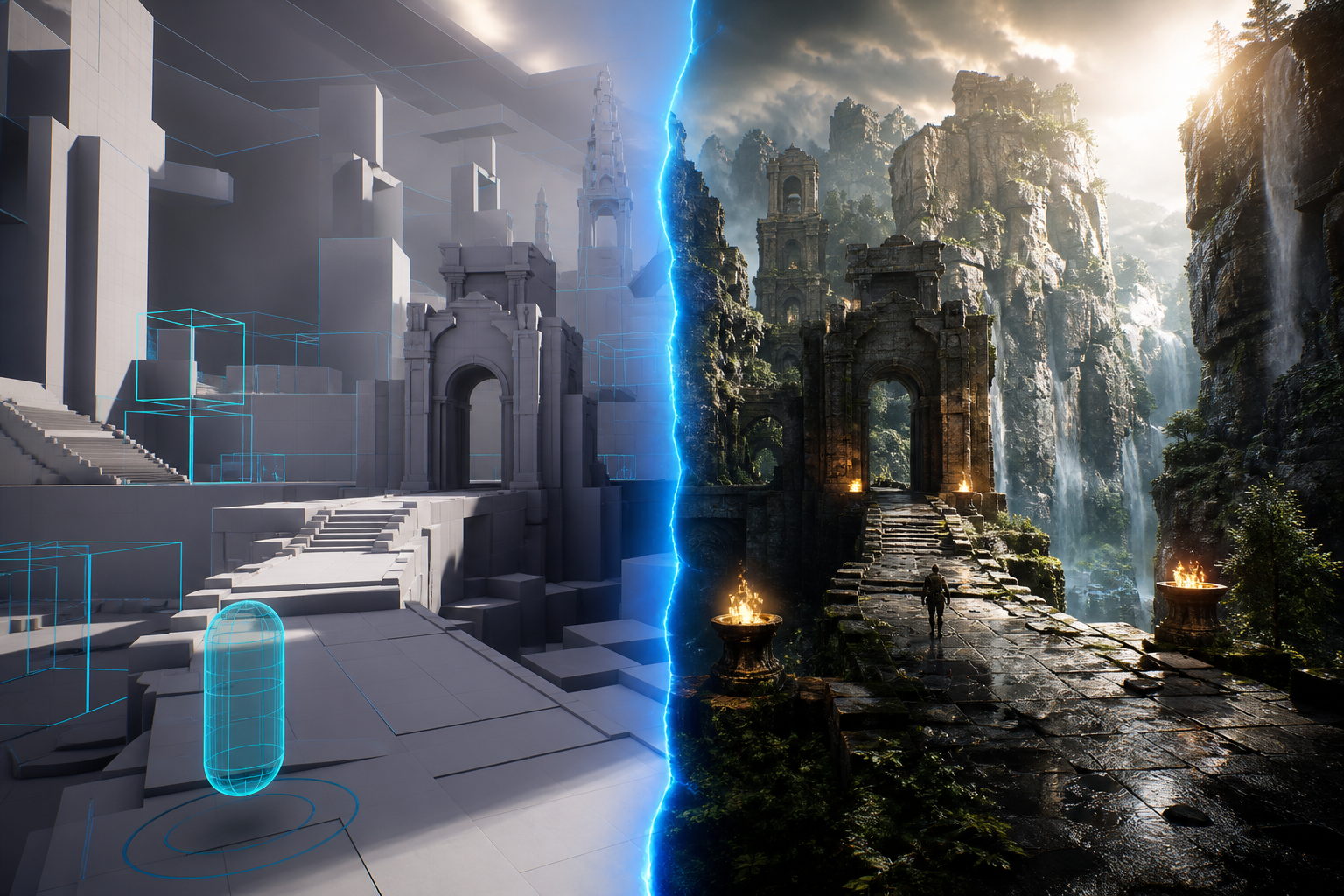
Designers author layouts, collisions, triggers, and numbers in the engine — classic white-box craft. At runtime:
- The User Client captures input and shows generated video.
- The Game Engine resolves actions, advances state, and emits a white-box observation plus camera pose.
- The Render Server turns that observation into streamed imagery. Style is locked once at session start with a text prompt and a first-frame image. After that, white-box video drives denoising; camera pose only retrieves view-relevant history.
Player actions, object properties, event signals, and hidden flags never hit the generative model as undeclared conditions. A visual glitch can muddy feedback. It cannot rewrite collision law.
Training used ~300 hours of human-operated Unreal captures across 30+ scenes — paired high-fidelity and white-box streams at 1920×1080 / 60 FPS, plus camera poses and structured interaction records. Operators played like players: revisits, idle stares, hard viewpoint edges. Idle is data. Motion-only datasets teach models to twitch when the world should hold still.
Pro Tip
If your generative “game” cannot dump authoritative state on demand — cooldowns, triggers, collision results — you are shipping a trailer with a keyboard. Keep the rulebook in the engine. Let the model paint the consequence.
Runtime Numbers Worth Respecting
The generative path sits on a Wan2.2-TI2V-5B backbone with Helios-style hierarchical few-step distillation, LightTAE, and FP8 where it is safe. On one H100, steady-state chunk prediction is ~620 ms for 20 frames — about 32 FPS compute-side at 1280×768, ~34 GB peak VRAM.
End-to-end action-to-picture is still ~1.55 s today because the engine records a full white-box chunk before inference starts. That is prototype-honest latency, not fighting-game ready. Magpie’s own paper calls for frame-wise streaming so engine, encode, generate, and display overlap. Steal the architecture now; expect the latency curve to fall.
History stays bounded: early anchor block for identity, FOV-overlap retrieval for revisits, recent chunks for local motion. No unbounded KV growth. No secret gameplay tokens smuggled into the denoiser.
What To Steal For Your Pipeline This Week
1. Split authority. Engine = what happened. Renderer = how it looks. Write that boundary in your design doc before you fine-tune anything.
2. Condition on executed outcomes. Pass white-box (or G-buffer) frames that already reflect resolved collisions and placements. Do not ask the video model to invent legality mid-denoise.
Session init: style_text + first_frame_imageEach chunk: whitebox_rgb_frames + camera_pose (history index only)Never: raw actions, cooldowns, event flags as model tokens
3. Collect paired data on purpose. Same timeline, same camera, high-fid vs white-box. If you only have pretty video, you are training a rembrandt, not a renderer.
4. Measure the right latency. Report engine prep, transfer, and render separately. A fat “FPS” number that ignores white-box chunk wait will lie to your producers.
5. Prototype on white-box first. Magpie’s pitch is ruthless and correct: judge feel before you finish materials, lighting, and LODs — then skin the same playable skeleton.
Paper: arXiv 2608.27168. Project page: zhanxy.xyz/Magpie-website.
Conclusion
Generative games do not need the model to replace the engine. They need the model to serve it. Magpie is the cleanest public cut of that idea yet: Unreal keeps the rulebook, a distilled video renderer paints the white-box, and designers stay in the loop. Latency still has homework. The architecture does not. Build the split. Own the state. Then let the pixels catch up.
—Titus