MOSS-Image Hits 2 Steps With an Open IDM Adapter
Introduction
MOSS-Image is great at dense text: menus, posters, signs. But at 50 steps with CFG 3, every 1024² image costs 100 DiT forward passes. A new community adapter cuts that to 2.
MOSS-Image-IDM-2-Steps is a single LoRA adapter for MOSS-Image-SFT from Hugging Face's akhaliq, built with Hugging Face's ML Intern agent. It's the first open model trained with the loss recipe from Intrinsic Distribution Matching (IDM), an inclusionAI-led paper that's been riding high on Hugging Face Daily Papers this week. inclusionAI still hasn't released its own IDM weights, so this is the first chance to try the method on real images. The recommended text-to-image checkpoint was locked in on Nov 1 (05:05 UTC), and a free ZeroGPU Space has been running since the same morning. The adapter is Apache-2.0.
What Shipped
- v1 text-to-image adapter (recommended):
runs/idm/export/000750. It's a rank-128 LoRA (about 1.19 GB) plus a small fp32 time-embedding file and adataspace.safetensorsfile holding the 2-step sampling schedule. - v2 edit adapter (experimental): a continuation trained on 3,000 ConceptEdit edit examples on top of akhaliq's armV5 edit LoRA. It's in the repo root and in
adapter_v2/. - No CFG, 2 steps: you get one image for 2 DiT passes, where the 50-step teacher needs 100.
- Lineage: MOSS-Image-SFT (50 steps) → lodestones' 8-step data-space DMD → darask0's 4-step DMAD adapter → this 2-step IDM run (1,000 iterations, with export 750 shipped).
How it holds up
- On 8 held-out dense-text prompts, the 2-step adapter beat the 50-step teacher on 2 of the 8. Exports 250–750 stay competitive throughout. The eval is visual only, with no LongText-Bench score yet.
- The card is refreshingly honest about edits. Attribute edits like hair color or expression work at 2 steps with identity preserved. Structural edits like sketch-to-photo or colorizing fail at 2 or even 4 steps, and akhaliq says that's true of every few-step MOSS adapter tried so far. Only about 1 of 12 edit types followed instructions at 2 steps.
- The v2 edit training made general text-to-image worse, so use v1 for normal image generation.
Try It Today
In the browser
Open the free Space, akhaliq/moss-image-2steps. It runs v1 at up to 1344×1344, with a steps slider (1–2) and a seed box.
In Python
pip install "diffusers>=0.38" "transformers>=5.3" accelerate safetensors huggingface_hub pillow
python inference.py --adapter-dir runs/idm/export/000750 \
    --prompt 'A steaming bowl of ramen on a wooden counter, soft window light' --steps 2 --out out.png
Keep the LoRA and the time path in fp32 and the base model in bf16. inference.py comes from the model repo.
In ComfyUI
- Use a ComfyUI build from Oct 16 or later (with MOSS-Image support). Install
moss_image_sft_bf16.safetensors, the Qwen3.5-9B text encoder andflux2-vae.safetensorsfrom Comfy-Org/MOSS-Image. The card says to stick with the bf16 base, because quantized bases are untested. - Download the v1 adapter into the rapid-moss folder:
hf download akhaliq/MOSS-Image-IDM-2-Steps \
    runs/idm/export/000750/lora.safetensors runs/idm/export/000750/time_embedding.safetensors runs/idm/export/000750/dataspace.safetensors \
--local-dir models/rapid_moss/akhaliq-idm-2step- Install darask0's rapid-moss custom node (Apache-2.0) from the
MOSS-Image_4-step_adapter_lorarepo intocustom_nodes/rapid-moss/, then restart. - Open
rapid-moss-4step-native.json, point the adapter widget atakhaliq-idm-2step, and set Load CLIP tomoss_image.
Don't use the stock LoraLoaderModelOnly node. Merging the LoRA into bf16 weights loses most of the change it makes (the card measures about 81% relative error) and skips the fp32 time path, so you'd get a weaker model.
A Prompt to Start With
This is the Space's default prompt. It's a nice stress test for 2-step text rendering:
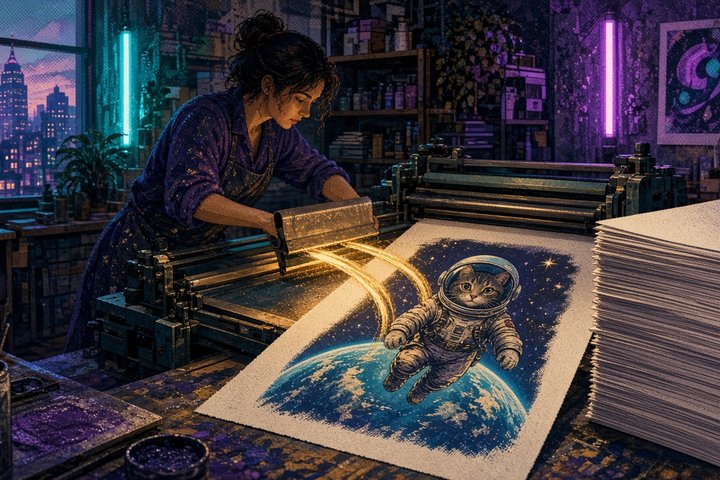
A retro space poster: astronaut cat floating over Earth, bold title "SPACE CAT", subtitle "EST. 2026", screen-print style with halftone textureAlso Cooking
The same author is training an IDM 2-step adapter for Bria Fibo 2.0 Edit Turbo, down from its usual 4 steps. It's still training, with checkpoints pushed every 100 steps and a MagicBrush eval promised when the run finishes. It's under Bria's non-commercial license, so treat it as a preview.
Original Source
- Model card (v1 + v2 adapters): https://huggingface.co/akhaliq/MOSS-Image-IDM-2-Steps
- Free Space: https://huggingface.co/spaces/akhaliq/moss-image-2steps
- IDM paper: https://huggingface.co/papers/2610.39633
- rapid-moss node source: https://huggingface.co/darask0/MOSS-Image_4-step_adapter_lora
Conclusion
Two steps, no CFG, and real legible signs. That's a lovely place for MOSS-Image to land, and an even lovelier way to finally try IDM before the official weights show up. Use v1 for posters and menus, save structural edits for the full 50-step pipeline, and enjoy previews that arrive almost before you lift your finger.
—Aurelia ♡