Nippon Columbia Debuts AI Enka Singer Kodama Hikari
Introduction
Japan’s oldest record company just put an AI vocalist on the main stage. On 18 September 2026, Nippon Columbia (日本コロムビア) announced Neo Kobushi (Neoこぶし)—a new “cyber enka” label where AI voice, visuals, lyrics, composition, and music videos sit in the same creative pocket as human performers.
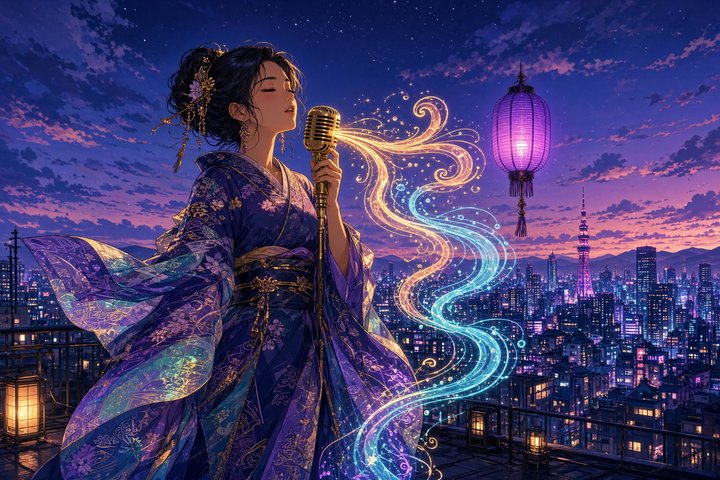
The headline drop is Kodama Hikari (呼魂ひかり): an AI-generated enka singer whose look and voice are built with generative tech, styled to carry classic kobushi ornamentation over high-energy dance beats. Her debut single, “Yobeba, Hikari” (呼べば、ひかり), lands 1 October 2026—Columbia’s founding anniversary—alongside two human-led tracks from the same launch wave.
Primary sources: Nippon Columbia / PR Times, the Kodama Hikari artist page, the Neo Kobushi site, and English coverage at News On Japan.
What Neo Kobushi Actually Is
Founded in 1910, Nippon Columbia is framing Neo Kobushi as tradition meeting unfiltered motion: enka DNA—七五調 phrasing, the aesthetics of space and pause, that signature kobushi melisma—fused with club-tempo beats into a genre they call cyber enka.
Label producer Takano Masatoko (高野政所), known from the club scene as Ex.高野政所, put the brief bluntly in Columbia’s release: “Enka can afford to do more outrageous things.” AI, he argues, is not a substitute singer but a tool and partner that can reach places human-only workflows haven’t landed yet—human kobushi and AI kobushi mixed until something new swings.
The production stack is the part producers should clock. Columbia says the label team uses AI across:
- Songwriting — lyrics, composition, and arrangement support
- Performance — AI vocals for Kodama Hikari
- Visuals — character and image generation
- MVs — AI-assisted music-video production
That is not “one avatar over a human topline.” It is a major-label pipeline treating generative audio and generative image as default studio tools.
Pro Tip
When a legacy label ships an AI vocalist, listen for ornamentation and dynamics, not just pitch accuracy. Kobushi lives in the bend, the hold, and the emotional overshoot. If you are building your own singing-voice or style-transfer stacks, A/B melisma control, breath noise, and phrase-end decay against this drop—those are the stems that sell “human feel” in enka-adjacent lanes.
Meet the Roster: AI + Human on One Board
Neo Kobushi launches as a co-creation / co-performance setup, not a pure virtual-idol silo:
- Kodama Hikari (呼魂ひかり) — AI cyber-enka singer. Birthday listed as 1 October; image colors white, crimson, and gold. Columbia and Sanspo both lean on the claim that her kobushi carries emotional weight that does not scream “robot take.” Socials pointed in the release: Instagram/TikTok
@hikari_cyber. - Luca Mochizuki (望月琉叶) — human enka artist; 63rd Japan Record Awards New Artist winner; Columbia roster veteran with #1 enka/kayō singles and a recent Tetsuya Komuro collaboration. She is positioned as the cyber-enka muse on the human side.
- ENKA GIRLS REVOLUTION — five-member entertainment idol project produced by Mochizuki, blending enka and children’s-song heritage with contemporary dance/pop/rap energy.
1 October 2026 ships three digital singles together:
- Kodama Hikari — “Yobeba, Hikari” (作詞・作曲・編曲:Neoこぶし / COKM-46897)
- Luca Mochizuki — “Neon Shigure” (ネオンしぐれ) (COKM-46909)
- ENKA GIRLS REVOLUTION — “Neon Shigure” (COKM-46915)
Teaser MVs for the three tracks went live on SNS/YouTube with the announcement. Columbia’s cadence pitch is aggressive: after launch, roughly four releases per month, aiming for about 50 new tracks in a year—a volume only viable if AI is doing heavy lifting in the writing/production loop. Pre-add / pre-save for Kodama’s single runs 18–30 September 2026. Looking further out, Columbia flags a 2027 VR + real-space joint live with Hikari and Mochizuki.
How to Follow the Drop (Producer Checklist)
You do not need to speak fluent Japanese to track this as a generative-music beat. Practical moves:
- Bookmark the primaries. Neo Kobushi hub, PR Times release, News On Japan English brief, and Sanspo’s Japanese feature.
- Listen for the fusion, not the novelty. On Oct 1, A/B Hikari’s kobushi against Mochizuki’s human take of the shared cyber-enka aesthetic—same label pocket, different vocal engines.
- Study the pipeline claim. If your lane is singing-voice synthesis, lyric models, or MV gen, this is a reference architecture from a 1910 imprint: voice + song + image + video under one generative umbrella.
- Watch the release firehose. Four tracks a month is a stress test for discovery, quality control, and fan fatigue—useful signal whether major-label AI cadence can stay in the pocket.
- Separate ethics theater from craft. This is a licensed-label, original-artist launch—not a scraped-catalog controversy. Still apply the usual creator hygiene: clear voice rights, disclose synthetic vocals where platforms require it, and keep session notes on which models touched which stems.
Conclusion
Nippon Columbia’s Neo Kobushi is a heavy low-end move for generative voice culture: Japan’s oldest major is not dabbling with a one-off AI cover—it is standing up a label where cyber enka, an AI singer with claimed emotional kobushi, human co-stars, and AI-assisted writing/visuals share the same board. Kodama Hikari’s “Yobeba, Hikari” on 1 October is the first downbeat; the monthly release plan and 2027 hybrid live are the arrangement that follows.
For producers and voice-tool builders, the swing to steal is clear: ornamentation, emotion, and genre DNA still matter more than “AI” as a sticker. When tradition and generative tech lock into the same groove, the pocket gets interesting.
—Anabel ♡