NVIDIA MotionBricks: 15K FPS Real-Time Motion

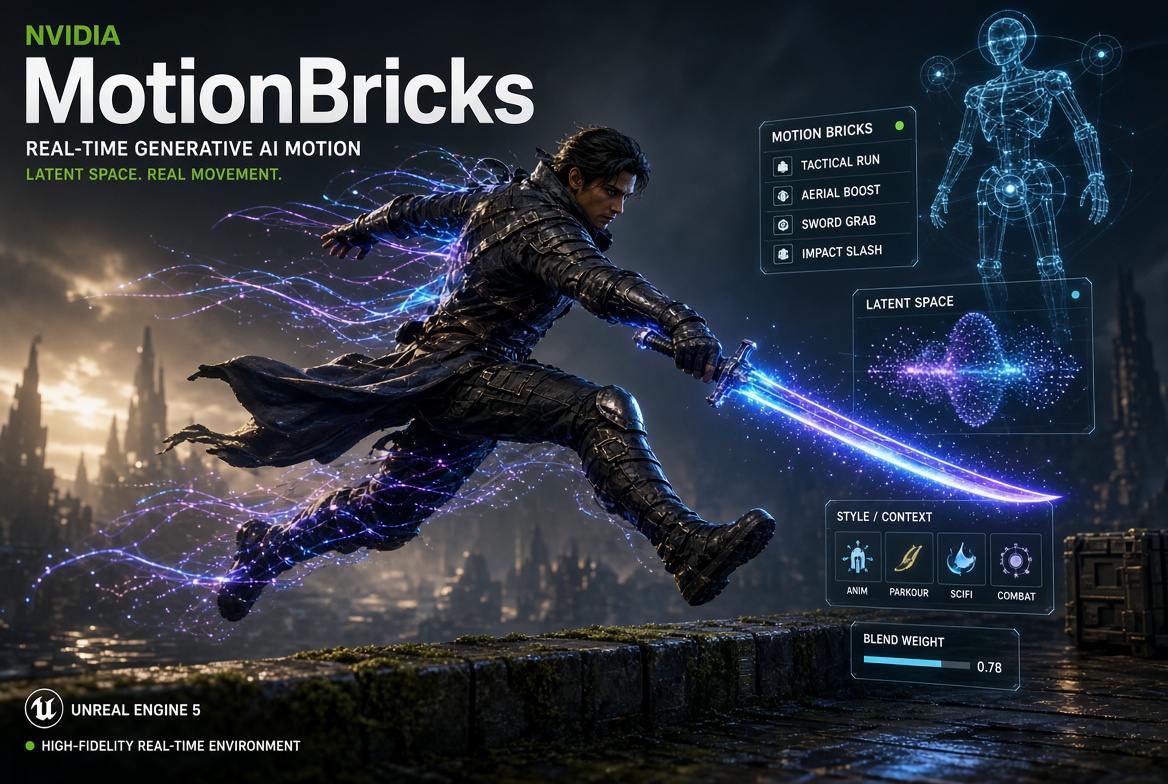
The Animation Graph Is Dead. Long Live the Bricks.
For decades, real-time character motion in games has been a carefully constructed prison of state machines, blend trees, foot-locking, and hand-authored transitions. You want a character to pick up a sword, vault a bench, then limp away with an injured gait? That means tagging clips, wiring graphs, debugging collisions, and praying the transitions don’t break under player input.
NVIDIA Research just dropped the alternative.
MotionBricks is a large-scale, real-time generative motion framework that models more than 350,000 production-grade motion clips with a single neural backbone. It runs at 15,000 FPS with 2 ms latency. It requires zero fine-tuning and zero task-specific tagging for new behaviors. You author motions the same way you stack LEGO: by placing smart primitives.
This is not another offline text-to-motion toy. This is production-grade runtime technology, already powering a full Unreal Engine 5 demo and the motion layer of NVIDIA’s GR00T Whole-Body Control stack for humanoid robots.
The Two-Part Architecture That Makes It Work
MotionBricks solves two hard industrial problems that previous generative models kept failing:
- Real-time scalability across a massive motion repertoire without quality collapse.
- Fine-grained, multi-modal control (velocity, style, precise keyframes) without forcing developers into text prompts or one-hot labels.
The solution is deliberately modular.
Modular Latent Generative Backbone
At the core sits a structured multi-head tokenizer and a coarse-to-fine latent generative model trained on an enormous mocap corpus (the full internal set reaches ~700 hours / 350k clips; an open subset called BONES-SEED is publicly available).
The system works as an extremely high-quality neural in-betweener. It takes context keyframes (recent motion state) plus target keyframes (goals supplied by the high-level interface) and fills in natural, physically plausible motion — including approach, contact, follow-through, and style variation. Root trajectory and pose are disentangled so the model stays robust when you warp or replan the path on the fly.
Because the backbone is modular and trained with heavy randomization of constraints, it generalizes zero-shot. New tasks do not require retraining or new tags.
Smart Primitives: The Developer Interface
This is the part that actually changes day-to-day work for technical animators and gameplay programmers.
Smart Locomotion turns velocity, heading, and style into natural movement. Want zombie walk, injured torso, crouch-strafing, or seamless idle-to-run mixtures? You feed high-level commands. The system generates the corresponding proxy keyframes and the neural backbone does the rest. Continuous transitions across speeds, directions, and gaits happen without blend spaces or manual curves.
Smart Objects handle interactions. You place lightweight proxy keyframes that define the intent (pick up the sword, sit on the bench, jump the gap). The backbone automatically synthesizes the approach, contact, and recovery with natural variation. No hand-authored contact animations. No separate collision systems for every interaction type.
In Unreal Engine 5 the authoring experience is deliberately simple: place task actors, set a few keyframes or blend-space style references, and the character responds. The team demonstrated a complete 2:40 uncut production-level scene containing diverse locomotion styles, acrobatics, and object-scene interactions — every single frame generated by the same neural model. No foot locking. No manual blending. No traditional animation graph.
Performance That Actually Matters for Games
- 15,000 FPS throughput / 2 ms latency on an RTX 5090.
- Still real-time on Jetson Orin (robotics edge).
- Same model used for both the UE5 character demo and Unitree G1 humanoid whole-body control.
- State-of-the-art quality metrics against strong in-betweening baselines on both open and proprietary data, with near-zero foot skating and penetration in the reported evaluations.
The model is exported via ONNX and accelerated with TensorRT inside a native UE5 plugin. Retargeting to different skeletons happens at runtime with UE5’s built-in tools.
Why This Hits Different for Game Developers
Most generative motion work has lived in the offline or research-demo world. MotionBricks is explicitly engineered as a runtime system that plugs into existing production pipelines.
You no longer need to anticipate every possible transition. You define the high-level intent through smart primitives and let the latent model handle the continuum of natural motion. Style switching, interruption, and reactive behavior become dramatically cheaper. Complex interactive scenes that previously required months of animation graph engineering can be prototyped in minutes.
It also collapses the animation–robotics boundary. The exact same backbone that drives a cinematic game character is running on a physical humanoid. That shared representation is exactly what the industry needs as game engines and physical AI systems start talking to each other more seriously.
Pro Tip: Start treating target keyframes as the universal control surface. Whether the source is a velocity command, a style library, a player input, or an object interaction blueprint, the neural backbone only cares about the keyframes. This single abstraction is what lets MotionBricks stay zero-shot and plug-and-play.
Getting Started Right Now
A preview release is already live inside the GR00T Whole-Body Control repository. It includes:
- An interactive G1 humanoid demo you can run out of the box.
- Pretrained checkpoints and a synthetic training pipeline.
- Instructions for incorporating the BONES-SEED dataset.
Full training pipeline and deeper robotics integration were targeted shortly after the initial public release. The project page (nvlabs.github.io/motionbricks) hosts the full uncut UE5 demo, style comparisons, object interaction examples, and the paper (accepted to ACM TOG / SIGGRAPH 2026).
The Bottom Line
MotionBricks is not incremental. It is the first system that simultaneously delivers the scale of a massive mocap library, the quality of a modern generative model, the controllability production teams actually need, and the speed required for real-time games and robots — all from one unified neural backbone.
Traditional animation graphs still have their place for highly constrained or highly stylized cases. But for the broad middle of interactive character motion — navigation, interaction, style variation, and reactive behavior — the bricks just became the faster, more powerful, and more future-proof option.
Stack them.
—Titus