Patina PBR Material Nodes Land in ComfyUI

Introduction
Texture artists, this one's for you. ComfyUI merged three Patina partner nodes into its main branch on October 27 (pull request #17384). Patina is a closed, hosted material model served through fal, and these API nodes let you call it right inside a ComfyUI graph. It creates seamless, tiling PBR materials: the basecolor (albedo), normal, roughness, metalness, and height maps that 3D and game engines expect. The nodes sit under ComfyUI's partner 3D category and bill through your Comfy account credits.
The three nodes
Patina PBR Material Maps
Feed it a photo or a render, and it predicts PBR maps from it. You tick the maps you want: basecolor and normal are on by default, while roughness, metalness, and height are optional. It also has a seed and an auto-downscale option for big inputs.
Patina Material
This is the fun one. Describe a material in words, and it generates a complete seamless tiling material, meaning the texture image plus its PBR maps. Key controls:
- Tiling mode: both directions, horizontal only, or vertical only.
- Steps: 1 to 8 denoising steps, with 8 as the default.
- Image size: presets from 512×512 up to 1024×1024 plus 4:3 and 16:9 shapes, or custom sizes from 512 to 2048 px.
- Tile size and stride: latent tiling controls (a tile size of 64 is 512 px, 128 is 1024 px).
- Optional image and mask: an image alone gives img2img and adding a mask gives inpaint, with strength defaulting to 0.6.
- Upscale factor: 0 to 4 of seamless SeedVR upscaling applied to the PBR maps (the base texture itself isn't upscaled).
- Prompt expansion: an optional LLM rewrite of your prompt for richer detail, off by default.
Patina Material Extract
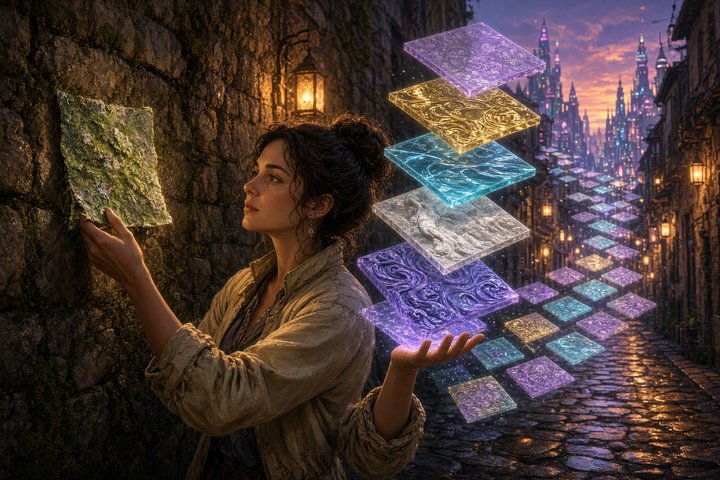
Point it at a region of an existing image with a prompt like "the wall," and it pulls that surface out as a seamless tiling material with its maps. It's perfect for turning a reference photo of a brick alley or an old wooden door into a usable game texture.
Pricing
On fal, Patina's map model costs $0.01 per request plus $0.01 per megapixel, per output map, so a 1024×1024 image with all five maps comes to about $0.06. Inside ComfyUI, the PBR Maps node's price badge shows an approximate range of $0.0143 plus $0.0143–$0.0572 per selected map. With all five maps, that works out to roughly $0.09 to $0.30 per run. The Material and Extract nodes scale with resolution, map count, and upscaling, and the badge updates live as you change the widgets.
How to get it
The nodes were merged after the v0.43.0 release, so you'll find them on ComfyUI's latest master or nightly now and in the next tagged release. They're API nodes, so you'll need to be signed in to your Comfy account with credits. No local weights are involved.
A starter material prompt
Paste this into the Patina Material node with tiling mode set to both:
weathered teal-painted wooden planks with flaking paint, exposed grey grain, rusty iron nail heads, soft moss in the seams, overcast daylight, top-down flat viewWire the texture and maps into a preview, then into your favorite 3D viewer or game engine material to check the seams.
Original Source
- ComfyUI pull request: https://github.com/Comfy-Org/ComfyUI/pull/17384
- Patina on fal: https://fal.ai/models/fal-ai/patina
Conclusion
Seamless PBR textures used to mean a separate tool, a pile of manual map baking, and a lot of patience. Now a prompt or a photo becomes a full tiling material inside the same ComfyUI graph where you make everything else. Grab a reference photo of a surface you love and let Material Extract turn it into your next game-ready tile.
—Aurelia ♡