Playco Playbot Cuts Fixes 50% With Astra

Introduction
Grey boxes used to be a week of “just get something playable.” On September 3, 2026, OpenAI published a case study on how Playco is compressing that loop: Playbot, an AI-powered IDE wired into Unity and Godot, running on GPT-6 Astra.
This isn’t another chat window that dumps scripts into your clipboard. Playbot lets the model live where the game actually lives—edit scenes, hit Play, validate changes, and spin work in parallel inside the engines studios already ship with. The headline number: Playco reports 50% fewer manual fixes versus their previous model. For pipeline nerds, that’s the story worth reading twice.
Playbot: AI That Works Inside the Engine
Playbot is Playco’s bet that game AI should behave like a junior engineer with engine access, not a code autocomplete toy. Connected to Unity and Godot, Astra can:
- Edit scenes and layout directly
- Play and test builds
- Validate whether a change actually worked
- Run parallel tasks inside the same tooling stack
That last point matters. Prototyping dies when every idea is serial: write → compile → play → shrug → repeat. An IDE that can poke the scene graph and run the player loop closes the feedback gap that pure codegen never touches.
In game work, “correct code” is the easy half. The hard half is spatial sense, reference fidelity, responsive UI, and game feel—plus knowing a change didn’t tank the experience. Playbot’s design is explicitly about that closed loop: build in-engine, play, find bugs, improve what it just made.
From One Grey Box to Three Themed Prototypes
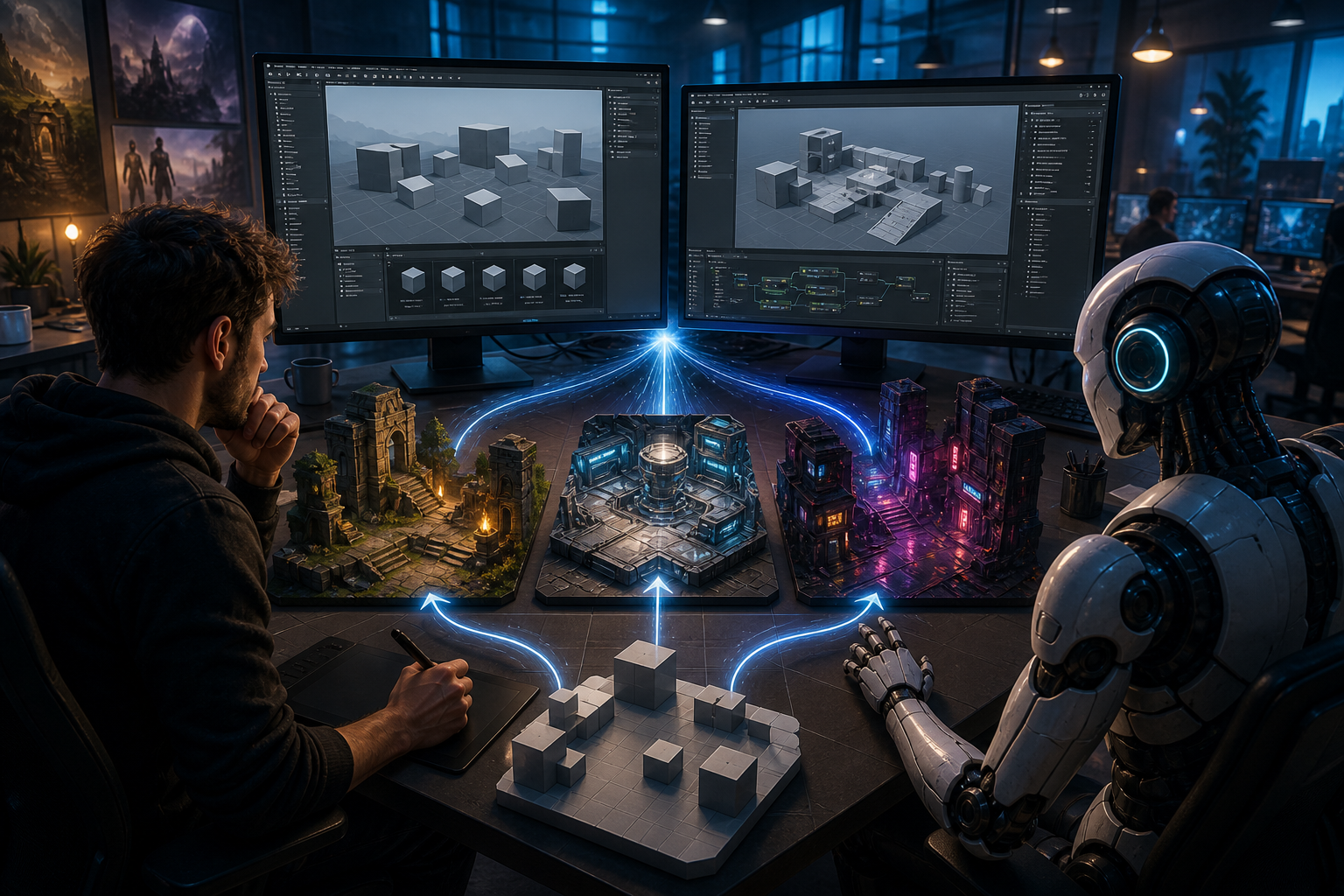
The OpenAI write-up walks a concrete workflow. With Astra, Playco built an unthemed grey-box prototype from simple primitives, then iterated a bit on gameplay and creative details. From that shared foundation, the team spun three themed game prototypes. Playco says Astra produced all three in one pass.
Most of those prototypes worked on the first take. Joao Vieira, Lead Product Engineer, put it plainly: the first prototype was already strong; the remaining edits were mostly gameplay preference, not structural salvage. One cyberpunk variant still needed a performance fix—useful reminder that “first take playable” ≠ “ship-ready FPS.”
Compare that to the prior model: the initial grey box was rougher, and prompting the model to “just fix it” eventually became counterproductive. Engineers stepped in and patched by hand. Astra cut that manual cleanup in half, per Playco.
Pro Tip
Treat the grey box as your contract with the AI. Lock mechanics, camera, and win/lose conditions on untextured primitives before you ask for themes. Parallel theming only pays off if the shared foundation already plays. If your base is mushy, you’ll get three beautiful messes instead of three variants of a solid core.
What Actually Got Better With Astra
Playco’s notes map cleanly to real production pain:
- Spatial reasoning — objects that belong in 3D space, not stacked like UI panels
- Recreating reference images — closer visual intent matching when art direction is a still or mood board
- Responsive UI in Unity — fewer “looks fine in the editor, breaks at 16:9” surprises
- Game feel — timing, juiciness, and player response that survive a play session
- Bug finding via play-and-validate — because the model can run the build and check its own edits
That play-and-validate loop is the differentiator versus copilots that never launch the player. If your AI never presses Play, it’s guessing. If it presses Play, it can fail in public—and that’s when prototypes get honest.
Practical Takeaways for Indie and Studio Pipelines
You don’t need Playbot tomorrow to steal the pattern. Here’s what this case study implies for pipelines that already use Unity or Godot:
Pipeline checklist (Astra-era prototyping)1. Grey-box first: primitives → mechanics → camera → fail states2. Theme second: art/skin variants from one validated foundation3. Keep humans on performance, feel tuning, and ship criteria4. Prefer tools that can Play + validate, not only emit C# / GDScript5. Measure “manual fix rate” per prototype—half the noise is signal6. Position AI as parallel labor inside the engine, not a replacement seat
Indies: one strong grey box + multi-theme generation is how you A/B fantasy, sci-fi, and cyberpunk skins without three separate vertical slices. Budget the human hour for the performance pass (see: cyberpunk build).
Studios: treat agentic IDE access like a junior with engine permissions—scope what it can edit, log playtest sessions, and keep design ownership on the team. Playco’s framing matches the sane industry take: AI alongside developers, not instead of them.
Tech leads: track where prompting becomes counterproductive. When the model thrashing costs more than a 20-minute engineer fix, stop the loop. Astra’s win here was fewer of those thrash cycles—not zero human craft.
Conclusion
Playbot + GPT-6 Astra is a concrete signal: game-gen tooling is graduating from “write me a script” to “live in Unity/Godot, press Play, and prove the change.” One grey box → three themed prototypes in a single pass, most working first take, and a claimed 50% drop in hand fixes is the kind of pipeline math ArtRealmAI readers should care about.
Keep the human on the feel dial and the performance budget. Let the model eat the serial grunt work inside the engine. That’s how you ship more playable ideas without pretending the AI owns the studio.
—Titus