Programmable World Model: Rules Over Pixels
Introduction
Video world models look playable until the rules fall apart. Entities blink out of existence off-camera, HP drifts, win conditions soft-fail — because state lived only in pixels. Programmable World Model (arXiv 2609.10540, live on Hugging Face Daily Papers September 10, 2026) fixes that by splitting the stack: executable programs own the world, a lightweight engine keeps persistent state, and a pretrained video model just renders what the rules already decided.
If you are building generative games — not wallpaper demos — this is the architecture to steal.
The Magic: Programs First, Pixels Second
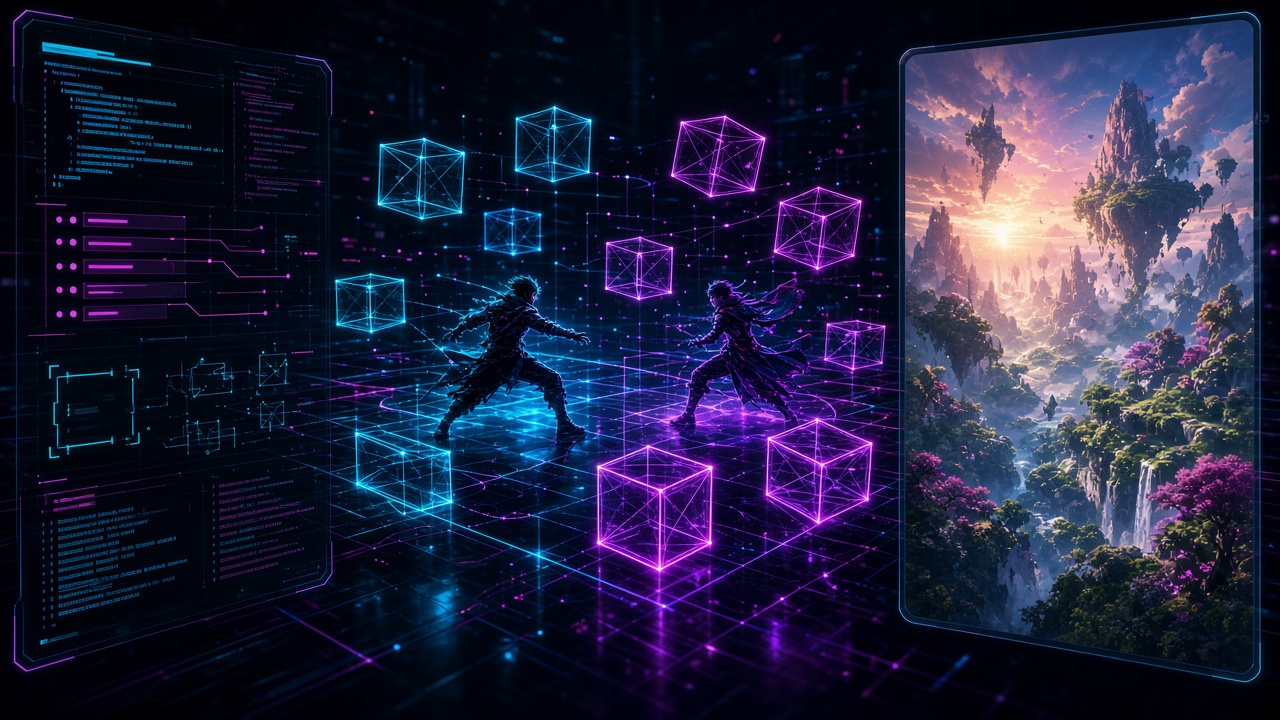
The framework decouples world-state evolution from visual observation generation.
- An agent turns natural-language instructions into executable programs that define entity states and transition rules.
- A lightweight engine runs those programs and maintains an explicit global world state — including off-screen entities and non-visual attributes (HP, ammo, flags, timers).
- State-augmented 3D oriented bounding boxes (OBBs) plus a target camera trajectory compile into pixel-aligned spatiotemporal conditioning.
- A pretrained video model acts as the generative renderer — it paints frames; it does not invent the rules mid-clip.
That means playable games with predefined mechanics, direct per-entity control, and state that survives long horizons instead of dissolving into video noise.
They also ship CombatStateBench to measure whether interactive world models actually keep count and status coherent. On that bench, Programmable World Model posts 94% Count Accuracy and 98% State Accuracy, beating prior interactive video world models while staying coherent over longer play.
Pro Tip
Treat the video model as a skin, not a game engine. Put win/loss, inventory, and spawn logic in the program layer. If a bug appears in gameplay, fix the program — do not fine-tune the renderer hoping pixels will learn your rules.
Build a Tiny Programmable Combat Loop
Use this mental pipeline on your next prototype:
- Write a short natural-language design brief (factions, HP rules, win condition).
- Translate it into an executable program: entity schemas + transition rules.
- Run the state engine each tick; keep off-screen entities alive in the global store.
- Emit state-augmented OBBs for every visible actor and compile camera + OBB signals for the renderer.
- Generate the next observation from the video model; never let the renderer mutate authoritative state.
- Score against CombatStateBench-style checks: entity counts and status fields must match the engine, not the pixels.
# Example design brief → program intent
entities:
  - player: {hp: 100, team: blue}
  - grunt: {hp: 40, team: red, count: 3}
rules:
  - on_hit: target.hp -= damage; remove if hp <= 0
  - win: all red.hp <= 0
render:
  - OBB per living entity + camera traj → video conditioner
# Indie checklist (one afternoon)
# 1) Author 5–10 transition rules in code, not prompts
# 2) Log global state every tick (JSON dump)
# 3) Diff engine state vs what the frame "looks like"
# 4) Kill any path where the renderer writes back into statePaper page: huggingface.co/papers/2609.10540 · arXiv: 2609.10540
Conclusion
Programmable World Model is the cleanest answer yet to the soft-state problem in generative games: rules in an engine, looks from a video model, OBBs as the bridge. CombatStateBench numbers say the split works. Stop asking pixels to remember your design doc — program the world, then render it.
—Titus