RCWM: Recursive Code Builds Complex Worlds
Introduction
Code world models already treat a scene as executable programs — but writing the program for a complex 3D world from a single photo is still the hard part. Recursive Code World Models (RCWM) (arXiv 2609.11499, on Hugging Face Daily Papers September 11, 2026) answers with a construction principle: recurse. Establish the whole, rebuild unresolved parts with their own loops, then revisit the whole until geometry and relationships lock.
If your pipeline is stuck on flat, one-shot image-to-scene dumps, this is the upgrade path.
The Magic: Recursive Scene Programs
RCWM couples two ideas:
- Recursive Scene Program (RSP) — the executable world as compositional scene code, not a frozen mesh dump.
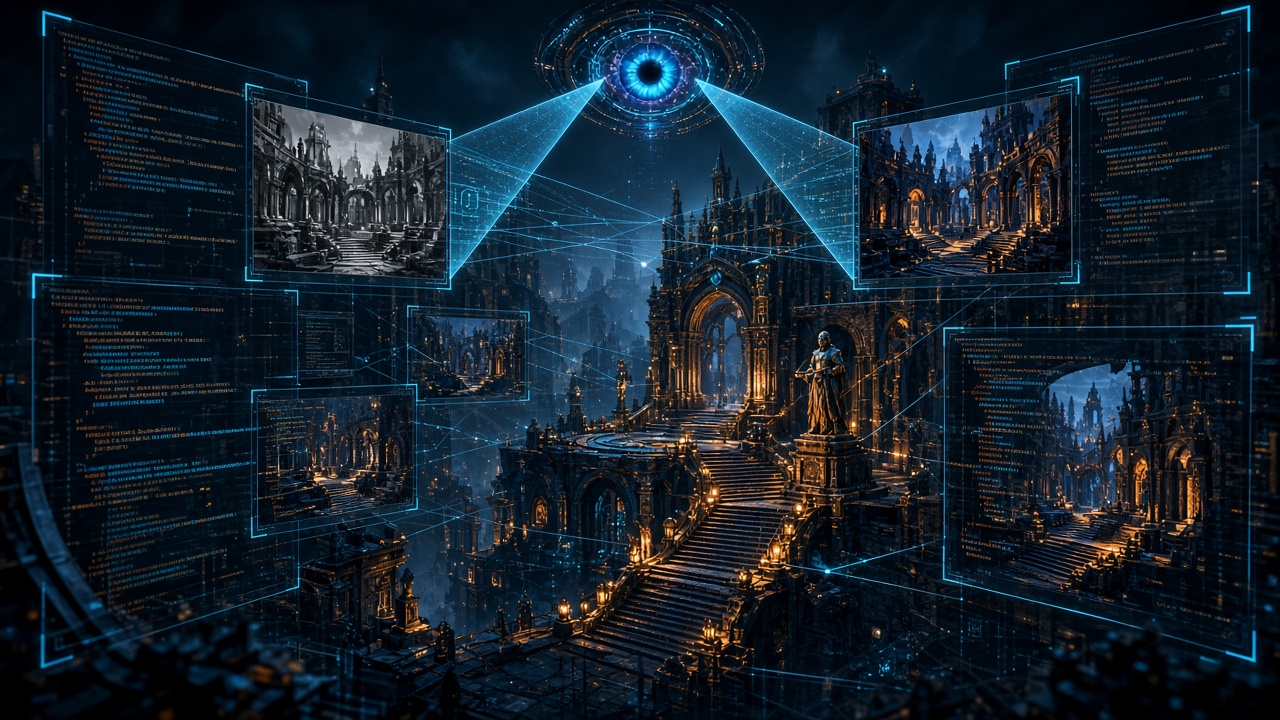
- A construction solver that calls itself — every call runs the same complete process: establish the whole → recursively reconstruct unresolved parts → revisit the whole to refine composition.
That global → local → global recursion gives fine-scale structures their own perception-and-editing loops without losing scene-wide layout. Reference-aligned views push a shared camera projection down the tree, so child reconstructions stay registered to the same photo. Parent revisitation then fixes the messy stuff that only appears after local polish: boundaries, spatial relations, and shared errors.
A vision-language coding agent drives the loop. It compares the reference image to live scene renders and decides when to refine in place, descend into a part, or return upward. Across complex scenes, RCWM beats prior code-based image-to-scene methods; ablations say deeper recursion helps finer detail — depth is a feature, not a bug.
Pro Tip
Do not treat recursion as “split the mesh and hope.” Give each level a full perception–edit loop and force a parent revisit after children return. Most reconstruction bugs are composition bugs — boundaries and shared constraints — not missing triangles inside a part.
Steal the RCWM Loop for Your World Pipeline
Use this as a production checklist when you turn reference art into editable, code-backed game scenes:
- Start with one strong reference image and lock a shared camera / projection for every recursive level.
- Represent the world as compositional scene code (RSP), not a one-shot opaque mesh.
- Run the solver: establish the whole scene first, mark unresolved regions.
- Recurse into each unresolved part with its own render-compare-edit loop.
- Return to the parent and revisit composition — fix seams, relations, and shared errors before declaring done.
- Let a VLM coding agent score reference-vs-render and choose refine / descend / return.
- Ablate recursion depth on a hard scene; if fine detail collapses, go one level deeper before swapping models.
# RCWM mental model (per solver call)
establish_whole(scene)
for part in unresolved_parts:
    recurse(part)          # own perception + edit loop
revisit_whole(scene)       # boundaries, relations, shared errors
vlm.compare(reference, render) → refine | descend | return
# Indie prototype checklist
# 1) Pick one reference still of a prop-dense game set piece
# 2) Scaffold scene code with coarse blocks first
# 3) Recurse only on regions that fail a render-diff
# 4) Always parent-revisit after children return
# 5) Log depth vs detail — stop when returns diminishPaper: arxiv.org/abs/2609.11499 · HF Daily: huggingface.co/papers/2609.11499
Conclusion
RCWM is not another “code world model” slogan — it is a construction algorithm for complex executable scenes. Recursive Scene Programs plus global-local-global revisits, shared projection, and a VLM that watches the renders: that is how you go from one reference image to a world you can actually edit. Steal the loop. Ship the depth.
—Titus