Recursive Game Creator: HKU's Open Harness Playtests Its Own Games

Introduction
Recursive Game Creator from HKU MMLab (The University of Hong Kong) just went open source: the team pushed its code to IMBALDY/RecursiveGameCreator under the MIT License on 2026-10-07, a day after the paper said "code is coming soon." It's an agent harness that takes a one-line game brief and builds an HTML or Godot game, then keeps improving it by actually playing it. You can run it today on macOS or Linux with Docker and your own model account.
The pitch is simple: a game that compiles isn't the same as a game that's fun. Most prompt-to-game tools stop at "it runs." This one loops design, build, play and review for several rounds and only keeps a new version if it plays better than the last.
How the loop works
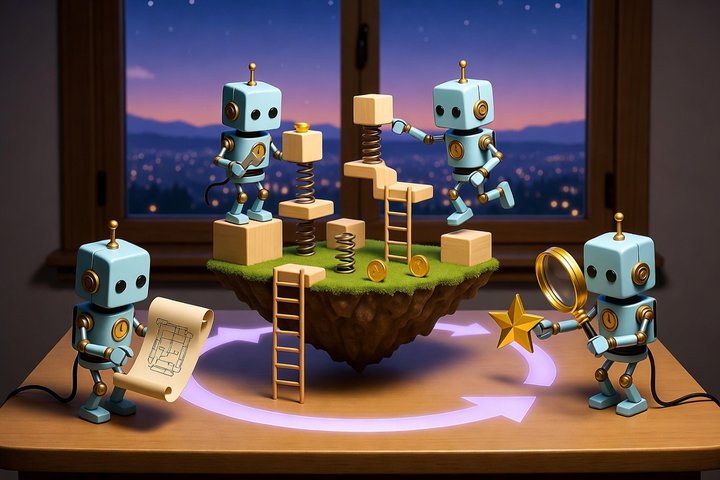
Four roles pass work around a recursive loop:
- Designer turns your brief, plus the last round's review, into a concrete revision plan.
- Builder implements candidate games from that plan.
- Player is "coding-native." Instead of clicking through a GUI one move at a time, it writes reusable gameplay policies and runs them through programmatic interfaces, so it can collect many play trajectories without a model call per action.
- Reviewer scores those trajectories, screenshots and your stated preferences against game-specific criteria, then writes feedback for the next round.
Version selection is strict. The first validated game becomes the retained version, and a later candidate replaces it only after passing the configured checks and winning consistently in both orders of an anonymous A/B comparison. That guards against the reviewer simply preferring whatever it saw first.
The numbers
From the paper, as restated in the README:
- 77.89 overall on GameCraft-Bench after three refinement rounds, which the authors call state of the art.
- 53.2% strict task success on GameASG-Bench, 34.1 points above the same-model baseline.
- 93.4% mean runtime-check pass rate, the highest among the compared methods.
- +5.19 points on GameCraft-Bench from round 1 to round 3, per the project page.
A user study in the paper also reports longer playtime and higher ratings. These are the authors' own benchmarks, so treat them as a claim until others reproduce them.
Assets: Hunyuan image and 3D, plus Blender
The quickstarts run with no asset services at all. If you add a HUNYUAN_API_KEY from Tencent Cloud in a local .env.hunyuan file, the Designer can request generated art: hy-image-v3 for text-to-image and hy-3d-3.1 for text- or image-to-3D, downloaded as GLB with a default request of 30,000 faces. The Builder can also write Blender Python scripts that export GLB props or PNG renders. The docs say plainly that Hunyuan outputs aren't yet piped into Blender automatically, so don't expect a full cleanup chain.
Install and first run
You need macOS or Linux, Git, Node.js 22 and a running Docker daemon with Compose and Buildx. The Docker runtime uses software rendering, so no GPU is required.
git clone https://github.com/IMBALDY/RecursiveGameCreator.git
cd RecursiveGameCreator
sh scripts/setup.sh
source .venv/bin/activate
codex login -c 'cli_auth_credentials_store="file"'
The role agents run through the Codex CLI, so you sign in with your own account. The example configs name gpt-6-astra; set model to whatever your account can use. Then generate a game:
game-agent start examples/quickstart-godot.json \
  --prompt 'Create a small platformer with responsive jumps, readable hazards, and a clear goal.' \
  --run-dir runs/first-godot
Each quickstart runs one round with three playtest trajectories per version. For real refinement, copy a config, set rounds to 3, and run it again. game-agent status, report, stop and resume manage long runs, and game-agent export-game runs/first-html --output exports/first-html exports the winning version's source and assets. Serve an HTML export with python -m http.server or open project.godot in Godot.
Prompt to try
A brief that gives the Player and Reviewer something measurable to chase:
Create a top-down roguelite arena game for keyboard and mouse. The player picks one of three weapons before each run, fights waves of enemies across five rooms, and collects one upgrade per cleared room. Hits must have clear visual and screen-shake feedback, enemy attacks must be telegraphed for at least half a second, the first room should be beatable by a new player, and there must be a restart button and a visible run timer.Try the games first
If you'd rather judge the output before installing anything, the project page hosts four browser games built with the harness: the action roguelite Whitebird, the physics bike racer Racing Rocket Trials with 24 courses, and two Chinese-language games, the visual novel See You Tomorrow and the diving and cooking sim Bluebay Night Kitchen. There's also a project film showing games changing from version to version.
Caveats
This is a research release that's a day old and has about 20 GitHub stars, so expect rough edges. Every round spends model calls on your own account, and Hunyuan image and 3D requests are paid Tencent Cloud API calls. Parts of the configuration docs are written in Chinese. The MIT license covers the code only. Paper figures, screenshots and other non-code assets are excluded, and third-party tools keep their own licenses.
Original Source
- Code (MIT): https://github.com/IMBALDY/RecursiveGameCreator
- Paper, arXiv 2610.08621: https://arxiv.org/abs/2610.08621
- Project page and playable games: https://imbaldy.github.io/recursive-game-creator/
- Hugging Face paper page: https://huggingface.co/papers/2610.08621
Conclusion
Prompt-to-game demos usually stop the moment something runs. Recursive Game Creator adds the missing step, which is playing the game and only keeping changes that make it better. If you already have a Codex login and Docker, a three-round Godot or HTML run is an easy way to see whether agent playtesting actually beats one-shot generation for your kind of game.
—Titus