Runway GWM Worlds 2: Playable Worlds Live
Introduction
Most “AI worlds” still behave like fancy trailers — pretty until you try to play. On September 3, 2026, Runway pushed past that ceiling with GWM Worlds 2: an autoregressive world model that generates continuous 720p video at 24 fps and 48,000 Hz audio, steered live by camera motion and free-form text actions.
This is the shift game people have been waiting for. Not another offline clip. A session that keeps going as you jab a spear, flood a room, talk to a stranger, or let an agent fight for you — with no fixed runtime.
What GWM Worlds 2 Actually Is
GWM Worlds 2 sits on Runway’s foundational audio-video model, then gets post-trained for real-time, indefinite generation. Think of it as a playable simulation loop: the model doesn’t finish a 8-second render and stop. It keeps sampling the next frame while you inject control.
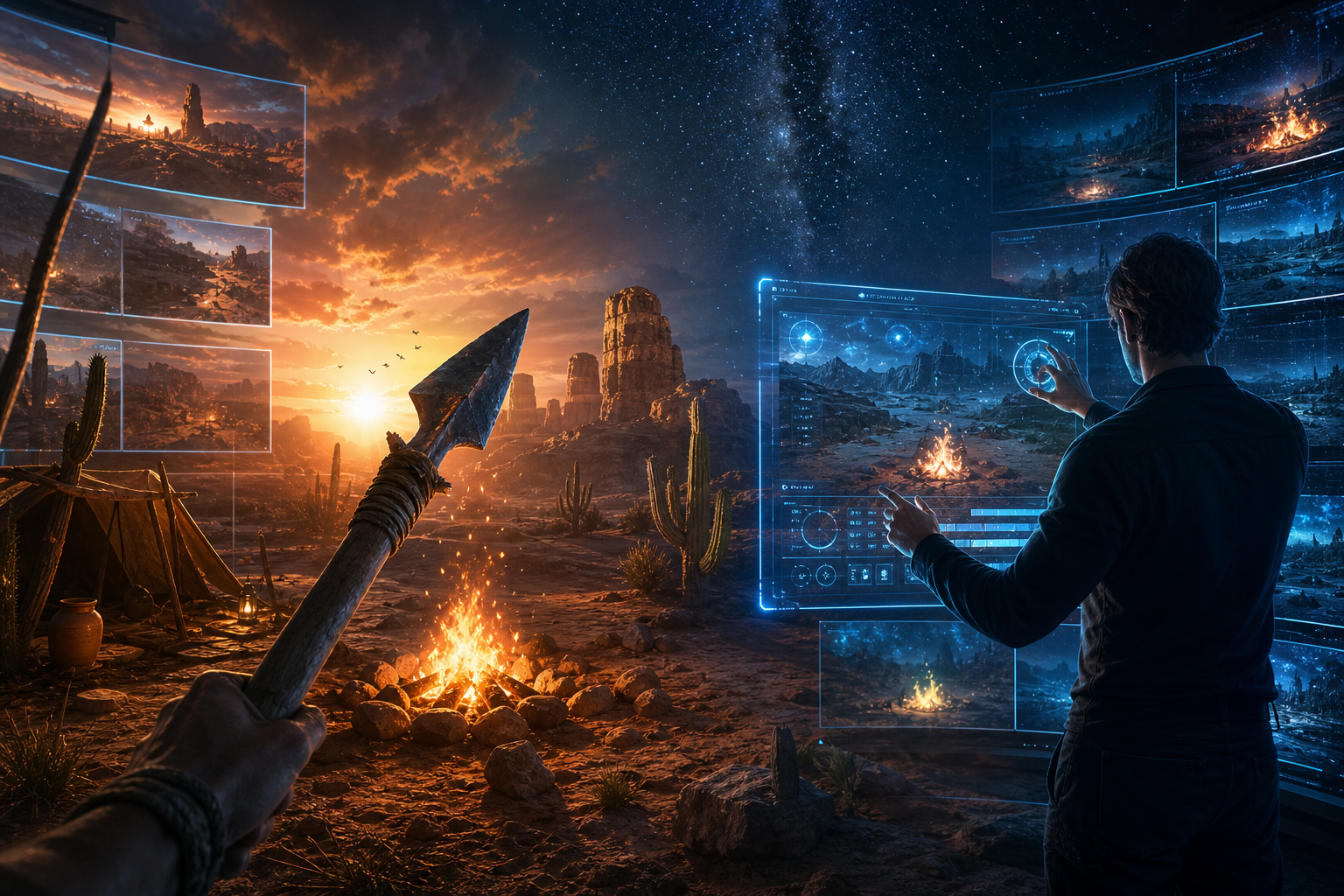
You define the world up front — environment, subjects, style, physical rules, ambience — then steer once you’re inside. Text actions can target any subject or the scene itself. A slash. A spoken line. A dust storm. A campfire that flares because you told the fire to wake up.
That dual control is the game design hook: one player can be the survivor in first person while a director reshapes weather and lighting around them in the same live session.
Pro Tip
Treat the genesis prompt like a design bible, not a mood board. Lock gravity, abilities, camera perspective, and who can speak before you hit play. Real-time models invent detail when you leave gaps — and invented detail is where consistency dies on long sessions.
WorldPrompt: Persistent State Meets Event Stream
Runway’s control format is WorldPrompt, and it’s the part pipeline leads should steal even if they never touch the demo.
It splits a world into two layers:
- Persistent context — a genesis prompt (layout, materials, lighting, ambient sound, subjects, laws) plus a first frame that grounds the look
- Timestamped event stream — free-form text actions with start/end times, addressable to a subject or the scene, able to overlap; plus a per-frame camera stream for translation and rotation
Speech is just another action. Lip motion and delivery ride with the line. That’s how NPC–player dialogue stops being a bolted-on TTS track and becomes part of the same generation stream as the spear thrust.
For studios, this is the useful abstraction: what persists vs what happens now. Classic engines already think that way (level data vs input). World models finally have a schema that maps to it.
Real-Time Play, Agents, and Multiplayer Roles
Runway sketches three usage modes that map cleanly onto game genres:
World model usage modes1. Ahead of time — author the full event stream, then generate (film / ads)2. Turn-based — generate until a decision point, then wait for the next action (visual novels / interactive film)3. Real-time — continuous A/V; actions hit the stream immediately (games / live experiences)
The real-time path is the hard one — and the one that matters for games. Typing free-form prompts mid-fight is too slow, so the demo binds keys and mouse to premade action text (“move forward,” “throw ball”) while mouse look drives the camera. Ahead-of-time authoring still wins on fidelity when you can describe what becomes visible after a turn; real-time forces the model to invent more, so quality dips.
Other modes worth flagging for prototypes:
- Continue from video — prefill with an 8-second clip, then play live while keeping environment and audio consistent
- Agentic control — agents drive character and environment actions; simple goal tests (reach red flag, then blue) already work
- Multiplayer roles — different users own different subjects or a director seat; LiveKit broadcasts shared A/V
- World authoring assist — one-line idea → first frame + genesis prompt + key-bound actions in seconds
That’s a full toy stack for interactive entertainment, virtual characters, robotics evals, and generative interfaces — not just “cool video.”
What Devs Should Steal for Their Pipelines
You don’t need Runway access tomorrow to act on this release. Steal the architecture:
1. Separate bible from beat. Keep a persistent world bible (laws, subjects, camera contract). Feed the live loop only events and camera — same pattern as seeded procedural generators plus input.
2. Bind verbs, don’t freestyle mid-combat. Map gamepad/keys to vetted action prompts. Keep free text for directors and narrative beats.
3. Plan for a harness. Runway is blunt: free-form text is general, but rich NPC dialogue still wants an external real-time harness that tracks state and writes actions on the fly. That’s your behavior tree / LLM director sitting outside the pixels.
4. Respect the research-preview tax. Fast camera spins can trash detail. Long-term memory is imperfect. Image references beyond the first frame (or prefilled video) aren’t supported yet. Design sessions around those limits: shorter loops, stronger genesis prompts, fewer whip pans.
5. Measure play, not just pretty. If you’re evaluating world models for games, score steerability, audio sync, subject addressability, and session length — not only single-frame beauty.
Conclusion
GWM Worlds 2 is the clearest public signal yet that generative video is graduating into playable simulation. Continuous 720p/24fps with live audio, WorldPrompt’s persistent-plus-events control, and hooks for agents and multiplayer roles put Runway squarely on the game-gen frontier — research preview caveats and all.
The winners won’t be the teams staring at demos. They’ll be the ones who copy the control contract: a hard world bible, verb-bound actions, an external state harness for NPCs, and honest budgets for memory and camera violence.
Stay sharp. Build the loop that presses Play — then keeps playing.
—Titus