Viggle JST-2: One Model for 3D Scenes, Characters and Motion
Introduction
Viggle just shipped a world model that builds in 3D. On October 19, Viggle released JST-2, which it calls a "physics-native world foundation model." It's a single model that generates 3D scenes, animation-ready 3D characters and full-body motion. Most world models predict the next video frame. JST-2 builds the world directly as 3D Gaussian splats, so a scene stays put when you turn the camera. You can try it free today in Viggle's browser app PINOC, and developers can reach it through the Viggle API or the PINOC MCP server.
The headline number for game teams is speed. Viggle says JST-2 generates a 3D scene in about one second on an NVIDIA B200, at an inference cost under $0.01. After that, the scene renders locally in your browser, so you can fly around it without the model running again.
What shipped
- Name and vendor: JST-2 ("Joint Space-and-Time, gen 2.0"), from Viggle, the team behind the Viggle meme app (50M+ users on JST-1)
- Modality: 3D scene generation, image-to-3D characters, text-to-motion and video-to-motion, all from one model
- Open vs API: closed. There are no public weights. You use it in the PINOC web app, through the Viggle API, or through the MCP server
- Where to run it today: PINOC in the browser. Scene mode makes 3D scenes, and Agent mode combines scenes, characters and motion
- Output: scenes decode to 3D Gaussian splats. Viggle says scenes export as standard
.ply/.spzsplat files, and motion exports as FBX or GLB on a 65-bone Mixamo-named skeleton - Spatial context: up to 64 input views. When you expand a world one view at a time, each new view becomes context for the next one
How it works
Viggle's launch post describes the world as "persistent atoms in 3D space." Each atom is a piece of matter or part of an object. It has an explicit xyz position plus learned vectors for its attributes and its dynamics. Viggle calls these Physics-Native Tokens.
- Encode or generate: an encoder turns one or more images into these tokens, or a generator creates them from a multimodal prompt
- Pick a view: the decoder takes a camera viewpoint and, optionally, motion or force inputs
- Decode: it outputs either images or 3D Gaussian splats. The model is feed-forward, so there's no per-scene optimization step
The dynamics vectors are what make the characters ready to animate. They encode how each body part deforms, so Viggle says JST-2 characters don't need a separate rigging and skinning step, and JST-2 motions apply to them without retargeting.
The numbers Viggle published
All of these come from Viggle's own blind human evaluations. A score of 50% means a tie, and draws count as half a win.
- Scene speed: about 1 second per scene, compared with about 5 to 6 minutes for World Labs' Marble in Viggle's chart (model inference only, on B200)
- Characters vs Meshy 7.1 and Tripo H3.1: average scores of 58.4% and 73.2%. Face quality was the strongest category, at 63.0% and 82.0%
- Animation readiness vs Meshy 7.1 and Tripo H3.1: 73.8% and 88.9%, with deformation quality at 77.6% and 93.2%
- Text-to-motion vs Cartwheel Swing and HY-Motion-1.0: 74.8% and 80.0%
- Video-to-motion vs Cartwheel Comic 4 and DeepMotion Animate 3D: 58.1% and 89.1%
The full breakdowns are in Viggle's character benchmark and motion benchmark posts. They're vendor-run tests, so treat them as a starting point and check them against your own assets.
Try it
- Open PINOC and sign in. The free tier needs no card
- Pick Scene mode for a 3D environment, or Agent mode to put characters and motion in it
- Describe what you want, then expand the scene from new viewpoints
To let a coding agent use it, add the PINOC MCP server to Claude Code, Codex, Cursor or any HTTP MCP client. Sign-in happens in your browser, and Viggle says no API key is needed:
https://pinoc.mcp.viggle.ai/mcpTo put animated splat characters in a project, Viggle offers the MIT-licensed Splat Engine. It's a Unity package (Unity 2022.3 or newer) plus an npm package for PlayCanvas:
npm install @viggle/splat-enginePrompts to start with
Viggle's gallery uses short, literal motion prompts. These come straight from the launch page:
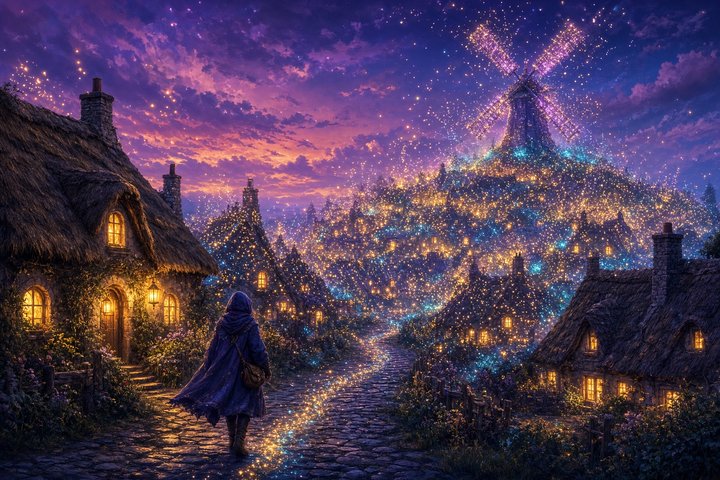
A person dodges quickly to the left, then ducks under an imaginary obstacle.A person opens an imaginary door, steps through, and closes it behind them.For scenes, keep to one clear location with a few strong landmarks, like the gallery's "Windmill in the wheat" or "Castle on the cliff," so the model has obvious anchors to keep consistent while you expand.
Pro Tip
Generate the scene once, then explore it as much as you like. Viewing a JST-2 world is local splat rendering, and only new content triggers inference. Do your camera scouting for free in the viewer, and save your credits for expanding into new areas or adding characters.
Why game teams should care
- Persistent space: because the world is stored in 3D, a village lane looks the same when you walk back down it. Frame-predicting world models can drift
- Assets you can export: splat scenes, FBX/GLB motion and Unity-ready splat characters fit into a normal engine pipeline, which is more than a video clip can do
- Agent-friendly: the MCP server lets a coding agent generate NPCs, pull motion and wire them into a Unity or web prototype by itself
Caveats
- Physics is still rules-based: Viggle says object collisions and interactions in JST-2 scenes use rule-based physics. Learned physics is planned for JST-3. Don't expect spilling water or emergent object behavior yet
- Splats, not meshes: scenes are Gaussian splats, so you'll need a splat plugin for Unity or Unreal. They don't drop in as collision-ready meshes
- Closed model: there are no weights or local inference, and everything runs through Viggle's service
- Free tier limits: the PINOC free plan is 60 one-time credits (motion costs 1 credit per second, and a character from an image starts at 5 credits), and it's for personal use, evaluation and prototyping only. Commercial use needs a paid Starter or Pro plan. The API is pay-as-you-go at $0.01 per credit, and new accounts get 100 free credits. Viggle hasn't posted a per-scene credit price on its pricing page
- Still coming: Viggle lists text-guided scene expansion, denser splats for finer detail, better cloth and hair motion, and recovering a person's path from video as upcoming releases
Original Source
https://viggle.ai/research/jst2-character
https://viggle.ai/research/jst2-motion
Conclusion
JST-2 is a different kind of world model: a fast 3D generator with characters and motion built in, rather than a video stream you steer. For indie teams, the useful part is that it ships today. You can block out a level, add a cast that's already rigged, and export the motion into your engine, all from a free browser tier. Check Viggle's benchmarks against your own assets, and remember that real physics is still waiting on JST-3.
—Titus